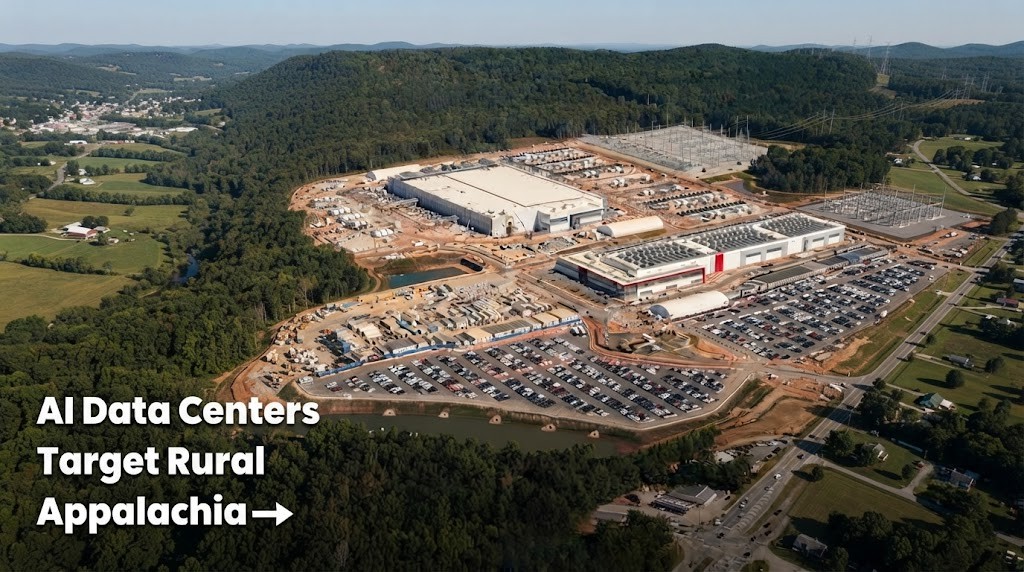
Across the ridges and river valleys of East Tennessee, a constant, low-frequency sound has replaced the historical quiet of the countryside. The sound comes from thousands of industrial cooling fans running around the clock inside windowless server buildings, the physical anchors of what technology companies market as “the cloud.” Built to power artificial intelligence and digital storage, these facilities are quietly reshaping the landscape, consuming land, straining the regional power grid, and drawing down local water supplies. Residents across the region have made their feelings clear at packed commission meetings and rezoning hearings: they resent these facilities, resent the noise, and resent what the buildout is doing to their land and their bills. Election after election, those same residents return to office the very lawmakers who built the incentive structure luring data centers to East Tennessee in the first place, a paradox that has become one of the defining contradictions of the region’s political life.
According to the Tennessee Valley Authority, data centers made up somewhere between 1 and 5 percent of the utility’s industrial load a few years ago. Today that figure sits at roughly 18 to 20 percent, and TVA officials expect it to double again by 2030. Industrial customers already account for about 60 percent of TVA’s total electric load, meaning the trajectory of a handful of server campuses now shapes planning decisions for an entire regional grid serving an estimated 10 million people.
To keep pace, TVA has proposed a $50 billion capital program, its largest in agency history, including new gas-fired generation and continued reliance on its nuclear and coal fleets. Regional analysts count more than a thousand data center projects proposed across the seven-state TVA territory, though officials expect a share to stall or never break ground.
The financial exposure for households has become a central point of dispute. Because data centers draw power at a scale and steadiness unlike typical industrial customers, running near-continuously and requiring dedicated transmission capacity, the cost of expanding the grid to serve them has raised concern among ratepayer advocates. TVA has responded by proposing a new rate classification for data centers, separating them from the manufacturing category they have shared since 2008, and weighing upfront capacity payments before new facilities connect, an effort officials describe as preventing the buildout from becoming a hidden surcharge on ordinary bills. A regional policy institute’s July report found data center electricity consumption in the Tennessee Valley has grown sevenfold in recent years, marking the first sustained rise in regional energy demand in two decades. The report pointed to Winter Storm Fern earlier this year, when roughly 345,000 Tennessee customers lost power, more than in any other state, as a preview of the strain a tightening grid could produce.
Concerns extend well beyond electricity. Cooling thousands of servers requires millions of gallons of water daily, and in counties already managing periodic drought and aging infrastructure, residents describe growing anxiety about aquifer depletion and the discharge of heated wastewater into nearby rivers and streams. In Anderson County, planning officials have pushed for new rules explicitly aimed at protecting water supplies and electrical capacity from unchecked data center growth. In Loudon and Knox counties, commission meetings addressing rezoning requests have drawn standing-room crowds, with residents describing the constant mechanical drone as a fundamental disruption to rural life and a threat to property values built around the region’s traditional peace and scenery.
The frustration echoes a pattern familiar to Appalachian communities, long weighing the costs of extractive industries, from timber to coal, against promises of prosperity. Data centers, once operational, typically employ a small permanent staff of technicians and security personnel, a stark contrast to construction-phase job counts cited during approval hearings. Economic development officials continue to tout capital investment and Tennessee’s fast-growing technology workforce. Critics argue the benefits accrue largely to distant corporate headquarters while the physical and financial costs stay local.
What distinguishes the East Tennessee story is how little the local uproar appears to translate into electoral consequence. Residents despise what the data centers have done to their communities, and say so loudly at every hearing available to them, yet they keep electing the officials who made the arrival of those data centers possible. State tax incentives, energy exemptions, and permitting advantages that have made Tennessee attractive to developers were largely built and championed by the same legislative supermajority East Tennessee voters have returned to office cycle after cycle. State leaders frame the resulting investment as evidence of a thriving, business-friendly economy.
Researchers who study the region describe the disconnect as a matter of separate political tracks rather than genuine contradiction. Voters tend to weigh candidates against a wide basket of concerns, including party identity, cultural alignment, and national issues such as gun rights and immigration, questions that rarely intersect with a specific rezoning fight back home. A resident who spends an evening urging county commissioners to protect the community’s water supply may, months later, vote along familiar partisan lines for a state legislator who backed the very incentive package that drew the developer in the first place.
Elected officials have found ways to acknowledge the anger while allowing the underlying growth to continue. State lawmakers passed legislation this year requiring data centers, rather than residential customers, to cover the cost of infrastructure upgrades tied to their own connections. TVA’s proposed rate restructuring follows a similar logic, aiming to ensure large industrial users cover their own grid costs. Local governments in Nashville’s Davidson County recently passed a package of regulatory measures addressing site placement and community impact, a sign that pushback is beginning to shape policy even where it has yet to alter statewide voting patterns.
For residents across East Tennessee, the standoff shows few signs of resolution. New project announcements continue to surface as opposition groups grow more organized, forming coalitions that share legal and lobbying resources across county lines. Whether that organizing eventually reshapes state-level elections remains an open question.
Analysts caution against expecting a dramatic shift soon. Absent a broader reordering of political priorities around energy, water, and land use, the same voters likely to fill a county commission meeting in protest may cast ballots the following November much as they always have, guided by loyalties built around questions far removed from the hum outside their window. The result is a region defined by a stark contradiction: people who despise the data centers reshaping their hillsides continue, election after election, to hand power to the very officials who invited those data centers in. The landscape they long defended and the political identity that continues to govern it now pull in opposite directions, with new facilities rising on ground their own representatives helped clear the way for.
November is coming, and the frontrunner for governor here in TN is taking donations from data center PACs. This election may be your last real say on data centers here in Tennessee.
So instead of getting distracted by scare words like “communist” or “socialist” or “China,” think about your kids, they’re the ones who’ll grow up living with this pollution.
-Tim Carmichael
 Echoes of Appalachia
Leave a comment