How a historic Appalachian lithium find is colliding with generations of distrust, forgotten property deeds, and fears of a new resource rush.
By any measure, the announcement was enormous.
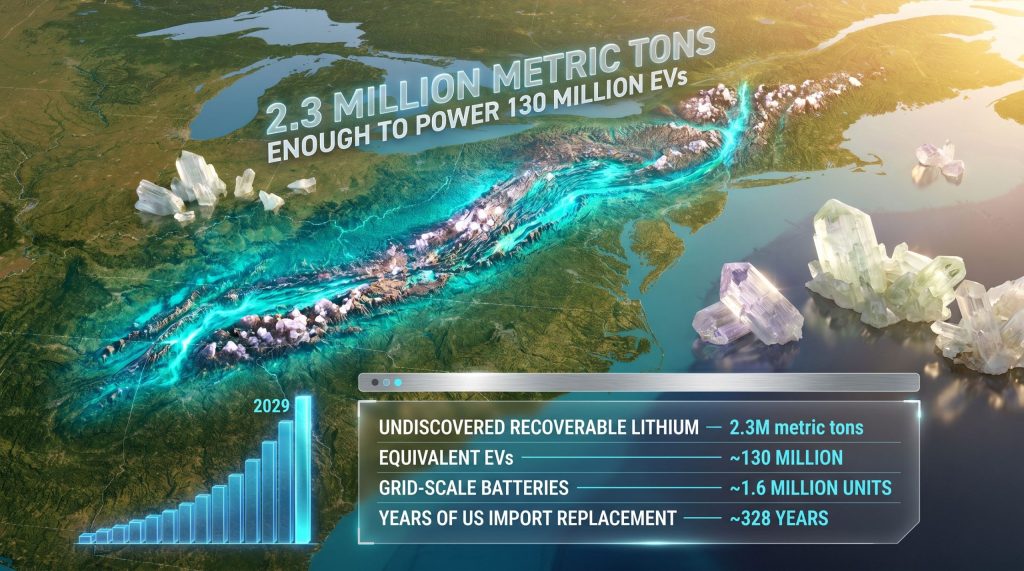
A recent U.S. Geological Survey assessment confirmed that vast quantities of lithium, a mineral essential to electric vehicle batteries and energy storage systems, exist beneath parts of the Appalachian region. Estimates suggest the resource could contain roughly 2.3 million metric tons of recoverable lithium, a figure with a potential market value measured in the tens of billions of dollars.
For clean energy advocates, the discovery represents a strategic opportunity. For mining companies, it signals a potentially transformative domestic supply source. For many residents across Appalachia, however, the news landed very differently.
Instead of excitement, the announcement triggered anxiety.
Instead of economic optimism, it revived old fears.
And instead of celebrating a new chapter in American energy independence, many communities immediately began asking a question rooted in more than a century of regional experience:
Who actually owns what lies beneath their land?
That question sits at the center of one of the most misunderstood legal realities in America and helps explain why a major mineral discovery has become tangled with internet conspiracy theories, distrust of government institutions, and concerns about corporate power.
A Discovery That Changed the Conversation
Lithium has become one of the most sought after minerals in the world. Demand continues to surge as automakers race to expand electric vehicle production and utilities invest heavily in battery storage infrastructure.
For years, public attention focused on lithium deposits in Nevada, South America, and Australia. Appalachia rarely appeared in conversations about the global battery supply chain.
That changed when researchers confirmed that significant lithium resources exist within geological formations stretching across portions of the Appalachian Basin.
Almost immediately, local social media groups, community forums, and regional activists began discussing what the discovery could mean.
Some focused on jobs.
Others focused on environmental risks.
Many focused on property rights.
Then a more controversial narrative emerged.
Online discussions began connecting the lithium discovery to past emergency responses during major natural disasters, including Hurricane Helene. Posts circulated claiming that government actions surrounding storm recovery efforts were secretly motivated by plans to secure access to valuable mineral deposits.
No evidence has emerged supporting those claims. Yet the theories gained traction because they tapped into something deeper than a single event.
They tapped into generations of distrust.
Why Conspiracy Theories Find Fertile Ground
Outside observers often dismiss Appalachian skepticism as misinformation.
Residents often see something else.
Many communities throughout Appalachia have spent decades watching outside corporations extract wealth from local resources while towns struggled with economic decline.
Coal, timber, natural gas, and other industries brought jobs and investment. They also left behind environmental damage, abandoned infrastructure, and lingering questions about who benefited most from the region’s natural wealth.
Against that historical backdrop, the lithium announcement arrived carrying significant baggage.
For residents whose families have lived on the same land for generations, the discovery raised concerns that another wave of resource extraction could be approaching.
The fear has less to do with lithium itself and more to do with the possibility that history could repeat itself.
When people already believe powerful institutions have ignored local interests in the past, they become more receptive to explanations that assume hidden motives.
That dynamic helps explain why unsupported theories continue circulating even as evidence remains absent.
Yet focusing exclusively on conspiracy claims risks overlooking a very real issue that many landowners are now discovering.
The legal reality may be shocking enough on its own.
The Split Estate Surprise
Across large portions of Appalachia, property ownership does not work the way many people assume.
A family may own a home.
They may own the farm.
They may pay taxes on the land.
They may have occupied the property for generations.
And yet they may own none of the minerals beneath it.
This arrangement is known as a split estate or severed estate.
Under a split estate, ownership is divided into two separate legal interests.
The surface estate includes the right to occupy and use the land above ground.
The mineral estate includes ownership of valuable resources beneath the surface.
These two rights can be bought, sold, inherited, and transferred independently.
Throughout the late nineteenth and early twentieth centuries, many Appalachian landowners sold mineral rights to coal, oil, gas, and timber companies. Some transactions occurred during periods of economic hardship. Others happened because landowners had little understanding of the future value of the resources involved.
Over time, many descendants forgot those agreements ever existed.
The paperwork remained.
The memories faded.
Now, the lithium discovery is bringing those old deeds back into the spotlight.
The Legal Shock Facing Landowners
For many Appalachian families, the most startling realization is learning that ownership of the surface does not necessarily grant control over what lies below.
American property law generally treats the mineral estate as the dominant estate.
That designation carries enormous consequences.
Because minerals have little economic value if they remain underground, courts have historically granted mineral owners broad rights to access and develop their resources.
In practical terms, this means the holder of mineral rights may possess legal authority to enter property and conduct extraction activities, subject to state regulations and reasonable accommodation requirements.
A surface owner cannot automatically veto those activities.
For homeowners who believed they fully controlled their property, the discovery can feel deeply unsettling.
Legally, the situation may be clear.
Emotionally, it often feels very different.
Imagine learning that a corporation headquartered hundreds of miles away owns a legal interest beneath your family farm because a relative signed an agreement generations ago.
Imagine discovering that a deed executed before World War I could influence what happens on your property in 2026.
That is the reality confronting some landowners as attention turns toward Appalachian lithium resources.
Who Owns the Lithium?
The answer varies dramatically from one parcel to another.
Ownership across the region is highly fragmented.
Some mineral rights remain in the hands of major energy companies that acquired them decades ago.
Others belong to investment groups that purchased resource portfolios over time.
Still others are controlled by private individuals, family trusts, state governments, or federal agencies.
In many cases, determining ownership requires extensive title research stretching back more than a century.
Property attorneys, landmen, and title specialists are increasingly examining old records to identify who controls specific mineral estates.
That process alone has generated concern among residents.
Stories are already circulating about outside companies seeking to acquire old mineral interests before lithium development accelerates.
Whether those acquisitions become widespread remains unclear.
Yet the possibility has added another layer of uncertainty to an already contentious issue.
Compensation and Conflict
One of the most common misconceptions involves compensation.
If a homeowner owns only the surface estate, that homeowner generally receives no mineral royalties from lithium production.
The royalty payments flow to the mineral rights holder.
Surface owners may be entitled to compensation for damages involving crops, fences, roads, structures, or other impacts associated with extraction activities.
However, those payments differ significantly from receiving a share of mineral revenues.
For families sitting above potentially valuable lithium deposits, the distinction can feel profoundly unfair.
From a legal standpoint, ownership rights were established through historical transactions.
From a personal standpoint, many residents see a corporation profiting from resources beneath land their family has occupied for generations.
That tension helps explain why discussions about lithium frequently become emotional.
The debate involves more than geology.
It involves identity, inheritance, and competing definitions of ownership.
A New Resource Rush or an Old Story Repeating?
Supporters of lithium development argue that domestic production could strengthen national security, reduce dependence on foreign supply chains, and create jobs in economically struggling regions.
Critics worry about environmental impacts, property rights disputes, and the concentration of profits among large corporate interests.
Both perspectives are likely to shape the next phase of the conversation.
What appears increasingly certain is that the lithium discovery has exposed a gap between public assumptions and legal reality.
Millions of Americans believe owning land automatically means owning everything beneath it.
In many parts of Appalachia, that assumption can be wrong.
The result is a growing collision between modern clean energy ambitions and property arrangements established generations ago.
The Real Story Beneath the Conspiracies
The most compelling aspect of the Appalachian lithium debate may have little to do with internet theories.
Conspiracy narratives attract attention because they offer simple explanations for complex events.
The underlying reality is far more complicated.
A massive mineral discovery has arrived in a region shaped by centuries of extraction, economic struggle, and skepticism toward outside power.
Families are discovering that property deeds signed by distant ancestors may still determine their rights today.
Corporations are examining old mineral holdings that suddenly appear far more valuable.
Communities are wrestling with questions about who benefits, who bears the costs, and who gets a voice in decisions affecting their future.
Those concerns do not require secret plots to become significant.
They are already reshaping the conversation across Appalachia.
The true controversy may not be whether anyone is stealing land.
The controversy is that many people are discovering, for the first time, that the law defines ownership very differently than they believed.
And in a region where land represents heritage, identity, and survival, that revelation may prove every bit as explosive as the lithium itself.
 Echoes of Appalachia
Leave a comment