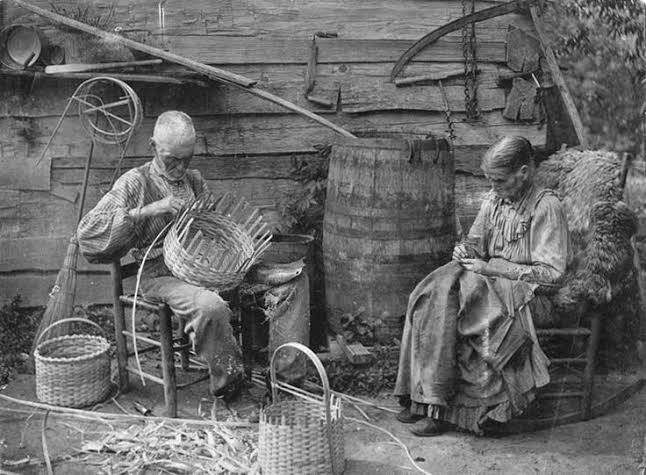
The blade moves through the work with a confidence that comes from decades of repetition. Every cut has a purpose. Every motion has been refined over years of practice. The person holding the knife knows what to save, what to remove, and how to complete a task that fewer people today have ever seen performed.
Across Appalachia, scenes like this are becoming harder to find.
A generation of specialized knowledge is reaching a breaking point. The people who know how to butcher an animal, preserve food, identify useful plants, repair old machinery, build with traditional methods, play regional music, and tell stories with the rhythm of a lifetime are aging. Fewer people are learning these abilities before they disappear.
The loss is larger than a collection of old techniques. These are systems of understanding created through observation, repetition, and problem solving. They represent decades of lessons gathered through hands-on work.
Much of this knowledge has never existed in manuals. It lives in the small details. The sound of an engine that signals a failing part. The appearance of a plant that separates one species from another. The feel of wood before it is shaped into a structure. The timing required to preserve food correctly.
When the people carrying that understanding are gone, replacing it becomes difficult.
For generations, butchering was a practical necessity for many Appalachian families. It required knowledge of anatomy, sanitation, preparation, and efficiency. A person learned how to handle the process by standing beside someone who knew the work and slowly taking on more responsibility.
The lessons came through observation. A younger person watched how tools were handled, how decisions were made, and how each part of the animal could be used.
Today, fewer people grow up around that process. Meat arrives packaged and prepared, separated from the work that produced it. The ability to process an animal remains valuable, yet the number of people who know how to do it continues to shrink.
The same pattern can be seen in canning.
A shelf filled with jars represents hours of preparation. It reflects an understanding of seasons, ingredients, storage, and timing. Someone skilled at preserving food knows how to prepare a large harvest and how to make careful choices that prevent waste.
Canning requires more than following instructions. It requires judgment developed through repetition. A person who has filled hundreds of jars recognizes details that are difficult to explain on paper.
Modern food systems have changed how people prepare meals. Many households have fewer reasons to preserve food themselves. As fewer people practice the craft, fewer people are available to teach it.
Plant knowledge faces an even greater challenge because much of it depends on recognition. Appalachia has long been home to people who understood local plants, their uses, and the methods involved in preparing them.
That understanding required attention to details that are easy to overlook. The shape of a leaf. The timing of growth. The difference between similar plants. The conditions that determine whether a plant is useful.
A field guide can provide information. It cannot replace someone pointing out the details that take years to notice.
The same issue appears in traditional building.
Older builders often understood how to work with materials available in their area. They knew how wood responded to cutting and weather. They understood construction methods through years spent creating, repairing, and improving structures.
Those methods represented more than craftsmanship. They showed an ability to solve problems with what was available.
Modern construction has changed the industry. New materials, tools, and methods have improved efficiency. At the same time, fewer people learn older approaches. When a builder with decades of knowledge steps away from the work, that understanding can vanish with them.
Machinery repair tells a similar story.
Across rural Appalachia, many farmers and mechanics developed a remarkable ability to diagnose problems. They could listen to an engine, observe a machine’s movement, and identify issues before taking anything apart.
Their knowledge came from years of repairing equipment, studying failures, and finding solutions when replacement options were limited.
Today’s machinery often requires specialized systems and advanced technology. Repair remains essential, yet fewer people develop the broad mechanical understanding that once existed among many rural workers.
Storytelling and traditional music carry another form of disappearing expertise.
A skilled storyteller understands timing, humor, emotion, and memory. They know how to hold attention and turn ordinary events into something people remember.
Traditional musicians develop their abilities through years of playing, listening, and performing. A song carries techniques and styles that may never appear in written form.
As fewer people learn these traditions directly, details begin to fade. A melody may survive in a recording, yet the methods behind the performance can disappear.
Hunting knowledge faces the same challenge.
A successful hunter understands far more than equipment. They learn patience, observation, safety, preparation, and decision-making. Much of that understanding comes through time spent alongside someone who knows the process.
Those lessons are difficult to transfer through technology alone. They are built through participation.
The decline of these abilities reflects changes happening throughout rural communities. Work has changed. Technology has changed. Daily routines have changed.
The question is what happens when the people who hold specialized knowledge become fewer and fewer.
Preserving these abilities requires more than recording them. A video can show how something is done. A document can describe the steps. Real understanding comes from practice.
Across Appalachia, some people are working to keep these traditions alive. Workshops, apprenticeships, community programs, and individual teachers are creating opportunities for younger people to learn crafts, repairs, food preservation, music, and other practical abilities.
The timing matters.
Many of the people who carry these abilities spent decades refining them. They learned through thousands of small moments: a mistake corrected, a technique improved, a problem solved.
That kind of understanding cannot be rebuilt overnight.
The last generation that knows how to perform many of these tasks is still here. The opportunity to learn remains available, yet it will not remain open forever.
A skill survives when someone chooses to learn it. It continues when someone practices it enough to understand it. It reaches the future when another person decides that knowledge earned over a lifetime deserves to continue.
-Tim Carmichael


Leave a Reply