
In a rare show of unity, lawmakers in Tennessee have taken a decisive step to elevate and preserve a defining feature of regional identity: the Appalachian dialect. Through the passage of Senate Bill 227 and its companion House resolution, the state has formally recognized the dialect as a vital component of Tennessee heritage, affirming its legitimacy and urging broader public respect.
The measure, approved unanimously by the General Assembly, signals a shift in how Appalachian speech patterns are perceived, moving away from long-standing misconceptions that have framed the dialect as a flawed version of English. Instead, lawmakers and scholars emphasize its deep historical roots, linguistic richness, and cultural importance.
At the heart of the resolution lies a call for inclusion in the Tennessee Blue Book, the official manual published by the Secretary of State. The proposal encourages a detailed account of the Appalachian dialect’s origins, development, and enduring presence across the state, particularly in East Tennessee. Such inclusion would place the dialect alongside other foundational elements of Tennessee history, granting it formal recognition within the state’s institutional narrative.
Supporters of the initiative, including Steve Southerland and Jeremy Faison, have framed the resolution as both corrective and celebratory. For decades, Appalachian speech has been subject to ridicule in popular culture, often portrayed through exaggerated spellings or caricatures designed to suggest ignorance. This practice, sometimes referred to as “eye dialect,” has contributed to a persistent stigma.
Southerland argued that such portrayals fail to recognize the dialect’s authenticity and historical continuity. He pointed out that many expressions commonly associated with Appalachia trace their lineage to early forms of English brought to America by settlers from the British Isles. Rather than representing linguistic deficiency, these patterns preserve elements of speech that have faded elsewhere.
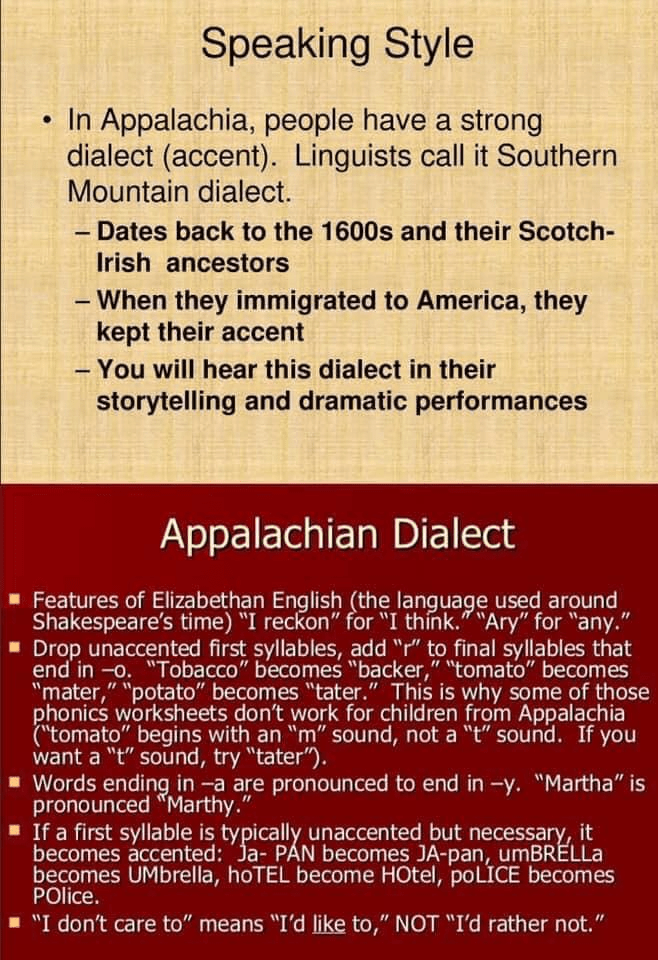
Faison echoed that perspective, stressing that Appalachian English represents a living link to the past. According to him, phrases such as “fixin’ to,” “reckon,” and “poke” offer insight into the daily lives and linguistic habits of earlier generations. He described the dialect as a cultural asset that deserves recognition rather than dismissal.
Linguists have long supported this view. Research indicates that the Appalachian dialect developed from a blend of Scotch-Irish, Irish, and early modern English influences, including forms often associated with Elizabethan-era speech. While the term “Shakespearean English” can be misleading in a technical sense, it reflects the idea that certain grammatical structures and vocabulary in Appalachia resemble those used during the period of William Shakespeare.
For example, the use of “a-prefixing,” as in “a-running” or “a-going,” appears in older English texts and remains present in some Appalachian communities. Similarly, double modals such as “might could” or “used to could” illustrate a complexity that challenges assumptions of simplicity or error. Scholars argue that these features demonstrate systematic linguistic rules rather than random variation.
The resolution’s emphasis on education and awareness aims to counter widespread misunderstanding. By encouraging the Tennessee Blue Book to include a comprehensive discussion of the dialect, lawmakers hope to provide residents and visitors with accurate information about its origins and significance. This step also carries symbolic weight, signaling that Appalachian speech holds equal standing with other recognized aspects of state identity.
Beyond formal recognition, the initiative addresses concerns about cultural erosion. Advances in technology, increased mobility, and the influence of mass media have contributed to a gradual leveling of regional accents across the United States. Younger generations often adopt more standardized forms of speech, sometimes distancing themselves from local linguistic traditions.
Supporters of the resolution view this trend with concern. They argue that language serves as a repository of collective memory, encoding values, experiences, and ways of life that define a community. When distinctive speech patterns fade, a portion of cultural heritage risks disappearing as well.
By affirming the legitimacy of the Appalachian dialect, Tennessee lawmakers aim to foster pride among residents who speak it. The resolution encourages educators, families, and community leaders to view the dialect as an asset rather than a liability. This perspective may influence how children are taught about language, promoting respect for linguistic diversity alongside proficiency in standard forms of English.
The initiative also reflects broader conversations about language and identity in America. Across the country, regional dialects and minority languages have faced pressure to conform to dominant norms. In recent years, there has been growing recognition of the value of preserving linguistic diversity, whether through bilingual education, cultural programs, or official acknowledgments such as this one.
In Tennessee, the Appalachian dialect occupies a particularly prominent place in that discussion. The region’s history of relative geographic isolation contributed to the preservation of older linguistic forms, creating a distinctive speech pattern that continues to shape local identity. From the rolling hills of the Smoky Mountains to small towns scattered across the eastern part of the state, the dialect remains an audible marker of belonging.
Community members have expressed support for the resolution, viewing it as long overdue. For many, the dialect carries personal significance, reflecting family traditions and shared experiences. The recognition offered by the state provides validation that their way of speaking holds value and meaning.
At the same time, the resolution stops short of mandating specific policies or programs. Its language focuses on encouragement and recognition rather than regulation, leaving implementation largely to educational institutions and cultural organizations. This approach allows for flexibility while still establishing a clear statement of intent.
Critics of similar efforts in other contexts have sometimes raised concerns about practicality or relevance. However, in this case, the unanimous vote suggests a broad consensus that the benefits outweigh any potential drawbacks. Lawmakers from different regions and political perspectives found common ground in the goal of preserving a unique aspect of Tennessee heritage.
The inclusion of the Appalachian dialect in the Tennessee Blue Book could serve as a starting point for further initiatives. Educational materials, museum exhibits, and community events may build upon this foundation, offering opportunities to explore the dialect in greater depth. Such efforts could also attract interest from linguists, historians, and tourists, highlighting the region’s cultural richness.
For younger residents, the resolution carries a message that their voices matter. In an era where social pressures often encourage conformity, official recognition of regional speech can reinforce confidence in local identity. This sense of validation may encourage individuals to embrace their linguistic heritage rather than suppress it.
The broader impact of the measure will unfold over time. Changes in perception rarely occur overnight, especially when stereotypes have persisted for generations. Yet the passage of Senate Bill 227 and its companion resolution represents a meaningful step toward reshaping how Appalachian speech is viewed both داخل and beyond Tennessee.
As the state moves forward, the challenge will lie in translating recognition into lasting cultural preservation. That process may involve collaboration between educators, researchers, and community members, each contributing to a shared effort to document and celebrate the dialect.
For now, the resolution stands as a statement of principle: that language, in all its forms, carries intrinsic value. By affirming the legitimacy of the Appalachian dialect, Tennessee has acknowledged a truth that scholars and speakers alike have long understood. Far from representing a deviation from standard English, the dialect embodies a rich tapestry of history, culture, and identity that continues to shape the lives of those who call Appalachia home.
-Tim Carmichael


 Echoes of Appalachia
Leave a comment