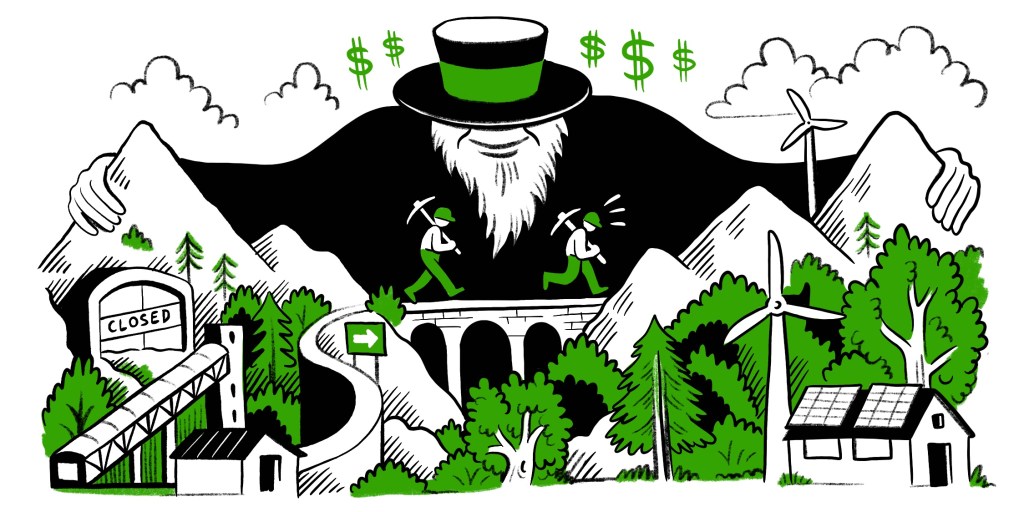
Appalachia’s political landscape has undergone one of the most dramatic shifts in modern American politics, transforming from a region once rooted in Democratic labor traditions into a Republican stronghold. Between 2000 and 2024, roughly 95% of Appalachian counties moved toward the Republican Party, with 203 counties shifting an average of 18.6 percentage points to the right.
States such as West Virginia and eastern Kentucky, once competitive political territory shaped by coal unions and New Deal era Democratic loyalties, now consistently back Republican candidates by large margins. Political analysts say the transformation has been driven by a combination of cultural alignment, frustration with federal leadership, and decades of economic stagnation.
Despite the political realignment, many communities across Appalachia continue to face persistent poverty, deteriorating infrastructure, and ongoing public health crises, including opioid addiction and the resurgence of black lung disease among coal miners.
Vice President JD Vance has emerged as one of the most visible national political figures associated with Appalachian identity, largely due to the success of his memoir Hillbilly Elegy, which chronicled his family’s roots in eastern Kentucky and the struggles of working class Appalachian communities. However, Vance himself was raised in Ohio, not Appalachia, a distinction that has sparked criticism from some residents who argue that national media and political leaders often simplify or misrepresent the region’s identity and experiences.
Vance has argued that Appalachian communities were neglected for decades by political elites in Washington and has promoted economic revitalization efforts focused on manufacturing, energy production, and rural investment. His message has resonated with many voters who feel abandoned by both political parties. However, critics argue that national politicians often romanticize Appalachia’s struggles without delivering meaningful long term economic change. But what he isn’t saying is that he supports all the cuts to infrastructure, Medicaid, and Food Stamps, and many other things that help poor people in Appalachia.
The debate over coal remains central to the region’s politics. While many residents see coal jobs as essential to local economies, others point to environmental concerns and health consequences tied to mining operations. Communities continue to wrestle with how to transition economically while preserving jobs and local identity.
At the same time, tensions over federal authority have surfaced in parts of the region. In the foothills of North Carolina, some residents recently mobilized against federal immigration enforcement efforts, reflecting a broader skepticism toward outside government intervention.
The upcoming 2026 elections, particularly in Kentucky, are increasingly viewed as a test of whether local leaders can move beyond partisan messaging and address longstanding infrastructure and economic concerns. Roads, bridges, broadband internet access, healthcare access, and education investment remain major priorities for many rural communities.
Critics of the region’s political direction argue that Republican leaders who have dominated Appalachian politics for decades have failed to significantly improve economic conditions, infrastructure, healthcare access, or poverty levels across much of the region. They contend that despite years of Republican control in many Appalachian states and counties, struggling communities continue to face declining industries, underfunded schools, addiction crises, and limited economic opportunity.
Those critics also argue that many Republican officials have successfully redirected public frustration toward Democrats and federal institutions, even in areas where Republicans have held substantial political power for years. Supporters of the GOP, however, maintain that Democratic environmental policies, federal regulations, and broader cultural divisions played major roles in Appalachia’s economic decline and political shift. When in fact they are the reason that Appalachia hasn’t flourished the way, it should have.
For many voters, the central question is no longer just party loyalty, but whether elected officials regardless of affiliation can deliver tangible improvements to daily life in a region that continues to struggle economically despite its growing influence in national conservative politics.
-Tim Carmichael


Leave a comment