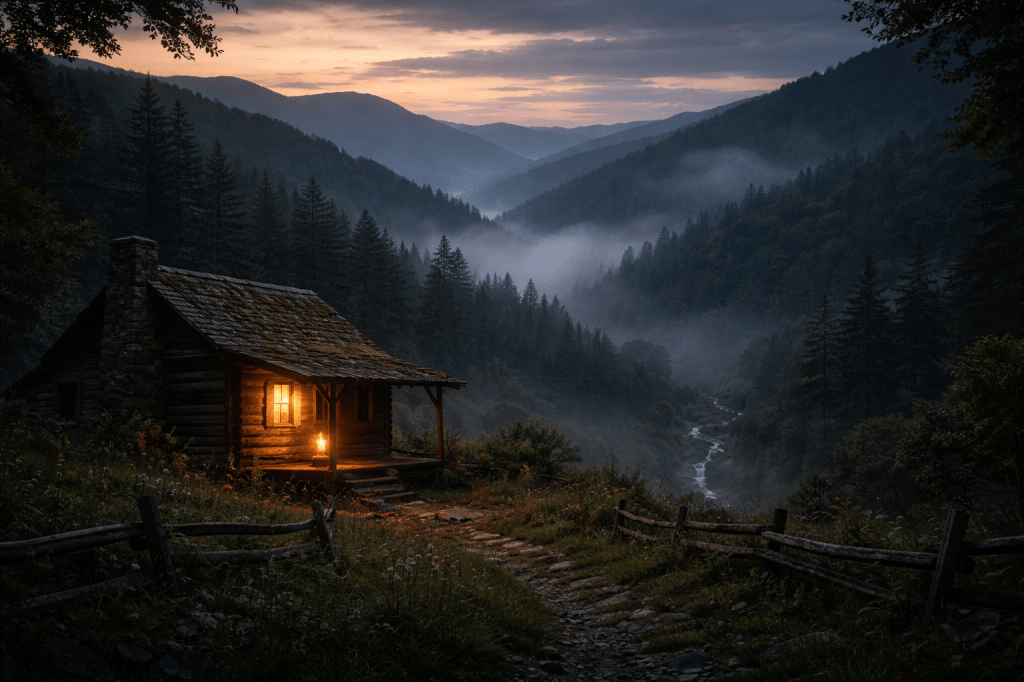
Stories move through the Appalachian region like weather across layered mountains, shifting shape as they pass from one generation to the next. In the mountain communities of the Appalachian South, history and imagination often share the same space, forming a tradition where lived experience and mystery intertwine. Folklore in this region grows from many voices, including settlers, Indigenous nations, and African American communities, each contributing language, belief, and narrative structure that shaped a distinctive cultural record.
The cultural foundation of these stories formed over centuries within the landscape of the Appalachian Mountains. European settlers, especially Scots Irish immigrants, brought oral traditions that included ballads, fairy tales, and accounts of wandering spirits. As these settlers established homes in isolated valleys and steep ridges, their stories adapted to new surroundings. Forests replaced distant castles, mountain paths replaced cobblestone streets, and unfamiliar wildlife replaced the symbolic creatures of older tales. The storytelling tradition evolved into a living record of adaptation to environment and circumstance.
Indigenous influence remains essential to the development of Appalachian folklore. The Cherokee and other Indigenous communities contributed narratives centered on nature, spiritual presence, and ancestral memory. These traditions often describe landscapes as inhabited by powerful forces that shape human experience. Stories of the Moon Eyed People, described as pale beings associated with ancient times, continue to circulate in regional storytelling networks. These accounts reflect a worldview where land and spirit exist in close relationship.
African American storytelling traditions added further depth through spiritual expression, oral history, and folklore shaped by endurance under hardship. Enslaved communities and their descendants developed narratives that blended West African cosmologies with the realities of life in the Appalachian region. Trickster figures, protective spirits, and accounts of conjure practices became part of the cultural fabric. These stories often carried encoded lessons about survival, resilience, and community care.
Industrial development in the mountains introduced new layers of narrative. Coal mining and logging reshaped both landscape and daily life, bringing economic opportunity alongside significant danger. Accidents, collapses, and workplace losses occurred with frequency, shaping community memory. Stories of spectral figures in mines or along logging routes emerged as symbolic representations of collective grief. These accounts offered a means of honoring those lost while expressing the emotional weight carried by families and towns.
In many Appalachian communities, folklore continues to serve as cultural identity rather than literal description of events. Older generations often preserve traditional beliefs and practices that guide daily life. Superstitions remain embedded in routines, including customs around thresholds, timing, and household behavior. These practices reflect inherited systems of meaning that connect present life with ancestral knowledge.
A tradition known as granny witchcraft persists in several rural areas. This practice involves herbal knowledge, spiritual prayer, and practical healing techniques passed through family lines. Practitioners often rely on plants gathered from surrounding hillsides and hollers, preparing remedies for common ailments. The tradition functions as both healthcare practice and spiritual expression, shaped by centuries of lived experience in remote environments. In many cases, practitioners describe their work as rooted in faith and observation rather than supernatural framing.
Even among those who approach folklore through historical or scientific perspectives, many describe the Appalachian landscape as carrying a distinctive presence. The age of the mountains, combined with dense forests and quiet valleys, contributes to perceptions of atmosphere that feels charged with memory. Geological history and environmental conditions provide explanations for many phenomena, while cultural interpretation continues to influence how experiences are understood.
Several well known Appalachian stories connect directly to documented historical events. One of the most widely referenced cases involves the Greenbrier Ghost. In 1897, within the region of what is now West Virginia, Elva Zona Heaster died under circumstances that raised suspicion. Her mother later reported visions in which Zona described the events leading to her death. These accounts prompted legal investigation that resulted in renewed examination of the case. Court proceedings ultimately led to the conviction of Zona’s husband for murder, creating one of the most unusual intersections of folklore and judicial record in United States history.
Another major legend originates from nineteenth century Tennessee and centers on the Bell Witch haunting. Reports from the Bell family described unexplained physical disturbances, voices, and interactions with an unseen presence. Accounts were recorded by multiple witnesses, including neighbors, physicians, and clergy members who documented their experiences in written form. These records circulated widely and contributed to the enduring reputation of the story. The Bell Witch narrative remains one of the most extensively documented supernatural legends in American folklore history.
In the twentieth century, West Virginia became associated with accounts of a winged figure known as the Mothman. Residents of Point Pleasant reported sightings of a tall humanoid creature with glowing eyes during the mid 1960s. These reports were submitted to local authorities and repeated across multiple independent accounts. The sightings occurred in the period preceding the collapse of the Silver Bridge in 1967. Some interpretations linked the creature to the disaster, while others attributed the accounts to misperception or environmental conditions surrounding the sightings. The story continues to influence cultural memory of the region.
The Silver Bridge collapse remains a documented historical event involving structural failure and significant loss of life. Its association with regional folklore illustrates how historical events and storytelling traditions can intersect over time. In Appalachian culture, such intersections often reinforce the sense that narrative and reality share overlapping space within collective memory.
Natural phenomena also contribute to Appalachian storytelling traditions. One of the most famous examples involves the Brown Mountain Lights in North Carolina. These luminous orbs appear along ridgelines near Brown Mountain and have been observed for centuries. Reports describe shifting lights that appear and disappear across distance and terrain. Scientific investigations have proposed explanations including atmospheric reflection, distant vehicle lights, and geological conditions that influence perception. The phenomenon continues to attract attention from researchers and visitors alike.
The presence of these lights adds to the broader cultural landscape of Appalachian storytelling, where physical environment and human interpretation interact continuously. Observers describe experiences shaped by geography, weather, and visibility conditions that influence how light behaves across mountainous terrain.
Modern Appalachian folklore remains active through storytelling, tourism, literature, and digital media. Writers and artists draw from traditional narratives to create new interpretations that reflect contemporary life while maintaining connection to older themes. Museums and cultural festivals preserve regional stories through exhibitions and performances that highlight historical context and oral tradition.
Academic study of Appalachian folklore emphasizes its role as a record of cultural adaptation. Scholars examine how stories reflect social structure, economic change, and psychological experience. Ghost narratives often express community memory of loss, while legends involving mysterious beings reflect uncertainty about environment and history. Each story contributes to a broader understanding of how people interpret experience through narrative form.
Tourism in the Appalachian region increasingly engages with folklore as a cultural resource. Visitors travel to sites associated with famous legends, historical cases, and natural phenomena. These journeys provide economic support for local communities while maintaining interest in regional heritage. Storytelling remains central to how many towns present their history to outsiders.
Within everyday life across Appalachian communities, storytelling continues in informal settings such as family gatherings, community meetings, and seasonal events. These narratives maintain continuity between past and present, reinforcing shared identity through language and memory. The persistence of these traditions reflects the importance of oral history in regions where written documentation developed alongside spoken culture rather than replacing it.
The Appalachian storytelling tradition demonstrates how cultural memory evolves across generations. Influences from multiple origins merge within a shared landscape, producing narratives that reflect both historical reality and imaginative interpretation. Over time, these stories adapt to new contexts while preserving core themes of survival, mystery, and connection to place.
Within the hollers of the Appalachian region, stories remain a living presence shaped by land, memory, and experience. They continue to reflect the complexity of human life in environments where history and imagination remain closely linked.
-Tim Carmichael
 Echoes of Appalachia
Leave a comment