Cherokee National Forest Faces a New Fight Over Its Roadless Lands
The Cherokee National Forest covers some 660,000 acres across East Tennessee, stretching from the Virginia line south toward Georgia and forming one of the largest pieces of public land in the state. Its mountains hold headwater streams, steep coves, hardwood forests and some of the most remote country left in Tennessee.
Now a federal policy fight has put a large portion of that backcountry at the center of a national debate over logging, roads and wildfire management.
The Trump administration is proposing to rescind the 2001 Roadless Area Conservation Rule, a federal regulation that restricts road construction and commercial timber harvesting within inventoried roadless areas on national forests. Across Tennessee, roughly 85,000 acres of national forest land fall under those protections, including significant areas within the Cherokee National Forest.
The proposal does not itself order timber companies into the Cherokee. It would remove the nationwide roadless restrictions and return management decisions to individual national forests through their land-management planning processes. That change could give Forest Service managers greater authority to approve roads and timber projects in areas that have received special protection for more than two decades.
For people who hike, hunt, fish and camp in the Cherokee, the issue reaches well beyond a federal regulation. It raises a basic question about what kind of forest Tennessee wants to keep for the next generation.
What the Roadless Rule Protects
The Roadless Rule was adopted in 2001 after years of debate over some of the most remote portions of the national forest system. The rule established broad restrictions on new road construction, road reconstruction and commercial timber harvesting in inventoried roadless areas.
Those places were identified for qualities such as relatively undisturbed soil, high plant and animal diversity, clean water, remote recreation and habitat for species that depend on large blocks of forest.
The Cherokee contains several of these roadless areas, including Beaver Dam Creek, Slide Hollow, Elk Creek, Bald Mountains, Horse Cove and Sycamore Creek. Sycamore Creek alone encompasses nearly 7,000 acres of montane terrain around the headwaters of the Tellico River.
Roadless land also carries a different meaning from designated wilderness. Congress has separately placed tens of thousands of Cherokee acres into the federal wilderness system, including acreage added through the Tennessee Wilderness Act of 2018. Those congressional wilderness protections remain a separate legal matter from the Roadless Rule.
That distinction matters because the current proposal concerns the roadless designation. It would not automatically erase every wilderness designation inside the Cherokee.
Why the Administration Wants the Rule Gone
Agriculture Secretary Brooke Rollins argues that the Roadless Rule has become an outdated barrier to forest management. The USDA says conditions have changed since 2001, including increased wildfire exposure, insect outbreaks, disease and the expansion of communities along the edges of national forests.
The department’s August 2026 proposal says rescinding the rule would give local Forest Service officials greater flexibility to respond to those conditions. USDA officials argue that managers closest to the land are better positioned to determine where thinning, timber harvests, road construction and other treatments are appropriate.
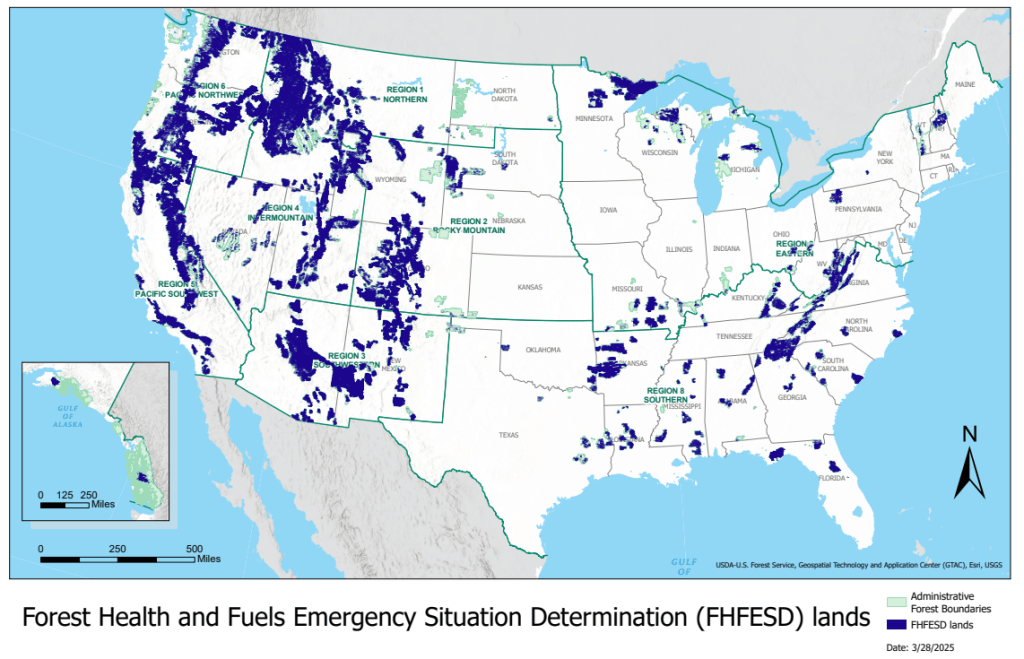
The administration also connects the policy to domestic timber production. Earlier actions in 2025 called for increased timber production on federal lands, while Agriculture Department officials declared an emergency situation covering more than 112 million acres of the National Forest System.
That emergency designation has become another point of controversy. Conservation organizations say the designation can speed up certain Forest Service projects and reduce some of the time normally available for environmental review and public involvement.
The administration presents the approach as a way to get work done faster in forests facing serious threats from wildfire, insects and disease.
The Wildfire Question
Wildfire sits at the center of the argument.
USDA says dense stands, insect damage and disease can create conditions that allow fires to burn more intensely. From that perspective, giving forest managers more freedom to thin trees and create access roads could provide another tool for reducing hazards.
Conservation groups challenge that reasoning, especially when it is applied broadly across forests with very different climates and ecosystems.
One reason involves the source of many wildfires themselves. Research reviewed by NASA has found that people cause at least 80 percent of wildfires in several eastern forest regions, including the temperate forests of the eastern United States. A 2025 USGS study also found human-caused ignition sources play a major role in wildfire patterns across the country, with important regional differences.
That creates an awkward question for road construction in remote forest country. Roads can make forest management easier, yet roads also bring vehicles, equipment and more human activity into areas that currently have limited access.
The wildfire debate therefore cannot be reduced to a simple argument that fewer trees automatically mean fewer fires. Forest type, weather, topography, ignition sources and the location of communities all affect wildfire behavior.
The Southern Appalachian Mountains also differ considerably from the dry western forests that dominate much of the national wildfire discussion. That difference has led conservation advocates and some scientists to question whether management approaches developed for western fire conditions can be applied broadly to Tennessee.
What Could Change in Cherokee National Forest
If the federal proposal becomes final, the Cherokee would gain greater flexibility to consider projects inside areas currently protected by the Roadless Rule.
That could include commercial timber harvests or road construction where individual projects receive approval through the Forest Service’s land-management process. The proposed rule itself contains an important limitation: rescinding the Roadless Rule does not automatically authorize logging or road building on every formerly protected acre. Individual projects would still require agency decisions and compliance with applicable laws.
Still, the change would remove a major federal restriction that has shaped management of these lands since 2001.
For residents around East Tennessee, the consequences could reach beyond hiking trails. Roadless mountain forests protect watersheds and headwater streams, provide habitat for wildlife and support hunting, fishing and tourism. They also preserve places where visitors can travel for miles through forest without encountering industrial roads or timber operations.
Those values rarely appear on a timber-sale ledger, yet they form part of what public forests provide.
A Decision Still in Progress
The administration’s proposal remains a proposal. The USDA published its formal rule in the Federal Register on August 20, 2026, along with a draft environmental impact statement and a request for public comment. The comment period closes September 21, 2026.
That leaves Tennessee residents with a chance to weigh in before the federal government decides whether to finalize the change.
The debate over the Cherokee will likely continue long after the September deadline. Timber production, wildfire protection, recreation, water quality and wildlife habitat all fall within the Forest Service’s broad mission. Finding the balance among those uses has been part of the national forest debate for generations.
What makes the current fight different is the scale of the proposed change. The Roadless Rule has shaped some of America’s most remote public forests for 25 years. Removing that national protection would place far more authority in the hands of individual forest managers.
For the Cherokee National Forest, that means the future of some of Tennessee’s most remote mountain country could increasingly depend on decisions made one project, one watershed and one road at a time.
The mountains will remain. The question is what kind of mountains Tennesseans will find when they return to them years from now.
-Tim Carmichael
 Echoes of Appalachia
Leave a comment