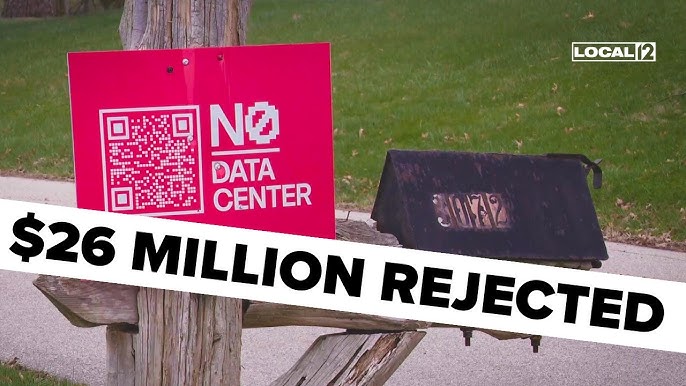
MASON COUNTY, Ky. — Three survey flags stood beside a cattle fence near Route 8 when news spread across the county that a local farming clan rejected a twenty-six million dollar land offer tied to an artificial intelligence server project. By sunset, diners, church parking lots, feed stores, grain depots, and school ballfields buzzed with argument.
Corporate planners sought several hundred acres from a 1,200-acre farm held across many families. Company representatives pitched construction work, utility expansion, tax revenue, and national investment prestige. The family declined every proposal.
That decision turned Mason County into a symbol across Appalachia, where rural communities face mounting pressure from technology corporations hunting cheap land, huge electrical capacity, and mountain water supplies for sprawling server compounds.
Now the county sits divided between residents chasing economic revival and residents fearing another era where outside wealth reshapes Appalachian land for somebody else’s gain.
At a recent fiscal court meeting, nearly every seat filled before proceedings began. Farmers leaned against side walls beside electricians, teachers, retired miners, mechanics, pastors, and small business owners. Several residents carried printed zoning maps marked through red ink circles around proposed utility corridors.
County leadership framed the proposal as a rare economic opportunity.
Opponents viewed the situation through a far darker lens.
For decades, Appalachian communities watched coal firms, timber operators, pipeline ventures, chemical processors, and industrial developers extract regional resources while local poverty rates stayed stubbornly high. Older residents across Mason County describe current negotiations as another chapter from that same story.
One cattle producer speaking outside the courthouse stated that major corporations always promise prosperity during early negotiations. According to him, local citizens hear glowing forecasts regarding growth and modernization. Years later, outside investors move onward while rural counties carry environmental strain and rising utility costs.
Inside Mason County, debate surrounding the rejected offer reaches nearly every public gathering. Sunday sermons drift toward property rights and stewardship. Restaurant conversations turn hostile. Local radio call-in programs stretch late into evening hours.
Some residents accuse the farming clan of blocking economic momentum during a period when younger generations continue leaving rural counties searching for reliable income.
Others praise the refusal as a rare act of defiance during an era when enormous corporations possess immense financial influence over local politics.
Several county officials continue defending technology expansion aggressively.
According to planning advocates, major server facilities could increase tax revenue, improve road infrastructure, strengthen regional utility systems, and attract secondary business investment. Construction contractors expect lucrative work tied to grading, excavation, electrical installation, concrete pouring, and equipment transport.
Critics argue those recruitment campaigns rarely include full public discussion regarding long-term consequences.
Water consumption remains among the largest concerns.
Modern server compounds require enormous cooling capacity. Residents across several Appalachian states already fear future pressure upon local wells, creeks, and municipal systems during severe summer drought periods.
Residents throughout Mason County repeatedly raise another question during public meetings.
Why should Appalachian communities sacrifice mountain resources so wealthy urban technology hubs can expand digital infrastructure?
That question sparks fierce applause during nearly every public hearing.
Critics describe the trend as modern resource colonialism.
Electricity generated across rural regions powers server systems serving distant metropolitan markets. Water drawn from mountain counties cools equipment processing financial transactions and artificial intelligence systems headquartered far away from Appalachia.
Meanwhile, local citizens fear rising utility rates linked toward infrastructure upgrades supporting industrial-scale energy demand.
Political frustration now burns across much of the region.
Residents accuse elected leadership of serving developers more eagerly than constituents. Several activists claim negotiations surrounding major projects frequently advance long before citizens receive meaningful opportunities for public input.
That frustration intensified after revelations tied toward another proposed server campus near the Appalachian Trail in Cumberland County, Pennsylvania.
Planning records circulating online describe a massive eighteen-building server complex valued near fifteen billion dollars. The proposed compound would sit roughly one-third of a mile from the historic hiking corridor.
Conservation advocates reacted furiously once project details emerged.
Tourism operators fear industrial infrastructure could reshape mountain scenery treasured through generations of hikers, campers, anglers, church retreat groups, and family vacationers. Residents across Cumberland County accused township leadership of advancing approvals quietly while public awareness remained limited.
Public meetings soon erupted into shouting matches.
County leadership defended the proposal through familiar economic language.
Jobs.
Growth.
Revenue.
Investment.
Opponents responded through another argument entirely.
Sacrifice.
Across Appalachia, many residents increasingly believe political leaders value corporate expansion above local wishes.
That perception drives much of the fury now gripping Mason County.
Several residents speaking during recent forums accused state leadership of treating mountain counties like industrial staging grounds for wealthy investors. According toward those critics, lawmakers celebrate billion-dollar agreements during press conferences while ordinary citizens receive little influence over negotiations reshaping local communities.
The divide stretches deeply through Mason County.
Some business owners support incoming development enthusiastically. Hotel operators foresee increased bookings tied toward construction crews. Equipment suppliers expect booming demand. Restaurant owners predict heavier traffic.
Many older residents remain deeply skeptical.
Several farming families fear industrial expansion could permanently alter regional identity built around agriculture, grazing land, church communities, hunting traditions, and local stewardship.
Technology corporations view that same territory through a completely different lens.
Developers see transmission routes, cooling access, utility expansion potential, and industrial acreage.
That collision between financial ambition and regional identity now defines the broader Appalachian conflict.
Inside Mason County, the farming clan whose refusal triggered national attention still refuses every proposal.
Supporters describe that decision as an act of regional self-determination during a period when enormous corporations wield extraordinary political and financial influence.
Critics continue portraying the refusal as emotional resistance standing against economic revival.
Following a recent county meeting, residents spilled from the courthouse into steady rain while arguments continued across homes and roadside diners.
One elderly resident paused beside a livestock trailer before driving home through winding mountain roads.
According toward him, the struggle consuming Mason County reaches far beyond a single server campus proposal.
Across Appalachia, rural communities now face a defining question.
Who controls mountain territory once billion-dollar corporations decide they want it?
For many residents throughout Mason County, elected leadership already delivered its answer.
Speak up now before it is too late!
-Tim Carmichael


Leave a Reply