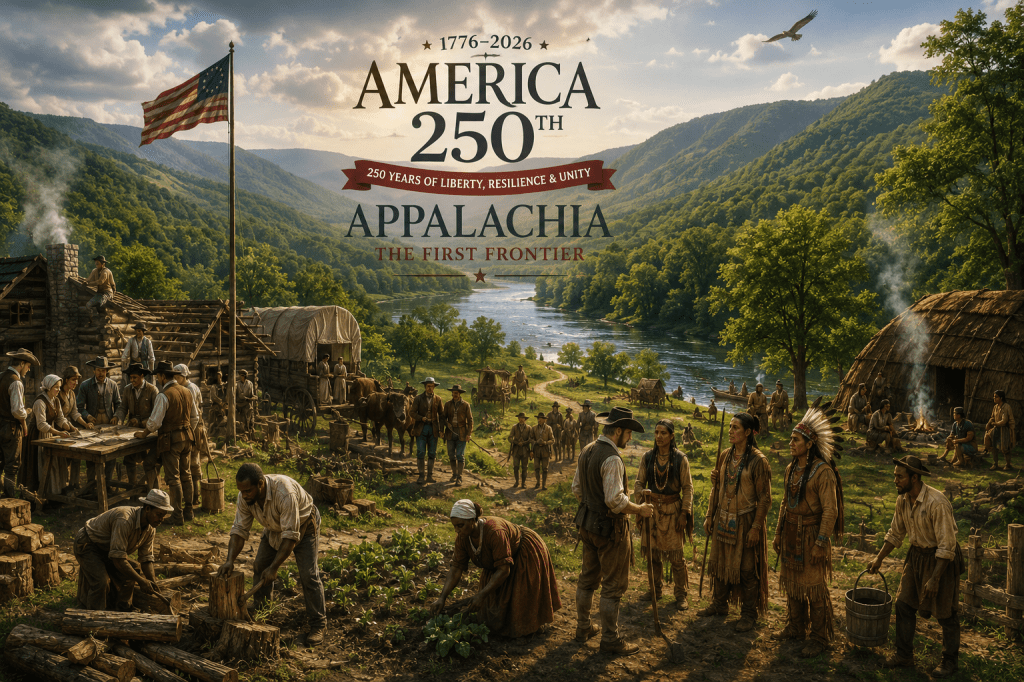
As the United States marks its 250th anniversary in 2026, the nation looks back not only to the signing of the Declaration of Independence in 1776, but to the wider frontier story that helped make that declaration real in the lived experience of ordinary people. Among the most important of these frontier regions was Appalachia, a vast mountain corridor that shaped migration, settlement, conflict, and the expansion of a young republic.
Long before European settlement, these mountains were the homeland of Indigenous nations, including the Cherokee and Shawnee, who built complex societies rooted in trade, agriculture, diplomacy, and deep knowledge of the land. Their presence defined the Appalachian world for centuries before colonial expansion reshaped it, and their legacy remains inseparable from the region’s history.
The earliest permanent Euro American settlements in Appalachia emerged in the early 1770s. Among the first were the Watauga Settlements in present-day Elizabethton, Tennessee, and communities in the Holston River Valley established around 1771 and 1772. These frontier settlements were not isolated accidents of migration. They were deliberate communities formed by families seeking land, opportunity, and distance from the crowded and increasingly regulated eastern seaboard colonies.
But these early Appalachian settlements were not built by one group alone. Alongside European settlers came enslaved Africans, present in the backcountry as early as the mid-18th century. Though Appalachia never developed the large plantation systems of the coastal South, enslaved men, women, and children were still part of frontier life. They cleared forests, built cabins, tended crops, and performed the hard physical labor that made settlement possible in a harsh and unfamiliar landscape.
As the region developed, East Tennessee became a launching point for continued migration westward. Around 1772, pioneers such as Jacob Brown established settlements in the Nolichucky River Valley. These river systems, including the Holston and its tributaries, became natural corridors of movement and trade, linking frontier communities and enabling further expansion into the interior of the continent.
In this same era, free Black Americans also became part of the Appalachian frontier. Some gained freedom through service in the American Revolutionary War, while others were emancipated by individual owners or born free. These men and women worked as laborers, farmers, blacksmiths, boatmen, and skilled tradespeople. Their contributions were woven into the daily survival of frontier communities, even as they often lived under restrictive and unequal laws.
Perhaps no figure is more closely associated with westward migration than Daniel Boone. In 1775, Boone helped blaze the Wilderness Road through the Cumberland Gap, opening a critical passageway into Kentucky. Thousands of settlers followed this route into the western frontier, establishing fortified communities such as Boonesborough. Along the way, many passed through early encampments in what is now northeastern Tennessee, continuing a migration that would reshape the future United States.
As settlement expanded, the Appalachian frontier became a place where the contradictions of the young republic were already visible. It was a land of opportunity and hardship, freedom and bondage, promise and displacement. Indigenous nations were pushed from ancestral lands. Enslaved people labored to make settlement possible. Free Black families carved out fragile spaces of autonomy. European settlers pursued land and independence. Together, these intertwined lives formed the reality of America’s early expansion.
By the early 1780s, settlement had pushed deeper into the southern mountains. In western North Carolina, permanent homesteads emerged in the Swannanoa and French Broad River valleys near present-day Asheville, as well as in the high country around Boone. These communities demonstrated extraordinary resilience, as families built homes, cleared fields, and established farms in one of the most geographically challenging regions of North America.
The Appalachian frontier also played a significant role during the American Revolution. Many frontier settlers supported the revolutionary cause, while others fought in militia campaigns defending their settlements. The mountains were not separate from the struggle for independence. They were part of it, shaping both strategy and survival during the conflict of the American Revolutionary War.
By the time the Revolution ended, the Appalachian region had become a gateway to the West. Its valleys and mountain passes served as the first great corridors of American expansion, carrying settlers into Kentucky and beyond. But more than that, it had become a mirror of the nation itself: diverse in experience, unequal in power, and driven by competing visions of freedom and survival.
Two and a half centuries later, as the United States reflects on its founding, Appalachia stands as a reminder that the nation was not built in a single place or by a single people. It was built across mountains and river valleys, through the labor of settlers, the resilience of Indigenous nations, the forced labor of enslaved people, and the perseverance of free Black Americans seeking autonomy in a divided world.
The story of America’s first frontier is not only a story of westward movement. It is a story of who built the country, under what conditions, and at what cost. And in that story, Appalachia remains one of the clearest and most powerful chapters in the making of the United States.
-Tim Carmichael


Leave a comment