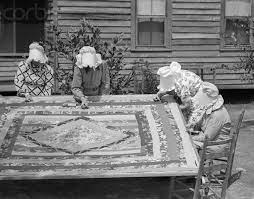
The quilt frame hung from the ceiling on four cords, and Granny would lower it when she sat down to work and raise it again when she was through. I grew up believing that frame belonged to the house itself, the same way a beam or a doorframe belongs to a house. Nobody built it. It simply came with the place, as far as I understood things then.
She sat beneath it for hours at a stretch, and I would stand there watching her hands. The needle went down through the layers, came back up, and the thread drew tight each time. I had no sense yet of what that kind of patience cost a person. I only knew Granny could sit longer than anybody I had ever seen, and that the quilt grew a little wider each time I looked at it, until one evening it covered the whole frame and she took it down.
The frame is gone now. I never found out what became of it. What stayed with me is the sight of it, and the sight of her under it.
It is easy today to talk about quilting like it belonged to some earlier, simpler version of Appalachia, something to admire behind glass. Women all over the country made quilts, and most of them made quilts for reasons that had little to do with sentiment. Winter came. A bed needed covering. A scrap bag filled up and had to be used before it filled again. In these hills, quilting was part of running a household, no different from canning or hanging wash.
Granny worked that way with everything. A dress with a torn skirt still had a good sleeve in it. A shirt worn through at the collar still had a yoke worth keeping. Whatever she could not use right away went into a box, and that box was never empty for long.
To me it looked like a box of rags. Granny looked at the same box and saw the quilt already sitting inside it, waiting for her to sort it out.
She would go through the pieces slowly, holding one against another, setting some aside and keeping others close. I recognized some of the cloth. My uncle’s old work shirt was in there. So was a dress my aunt had worn to church for two summers. Other pieces I could not place at all, faded past any pattern I could name. Some of it came from feed sacks, washed until the print disappeared or left alone if the print still had some life in it, then cut into an apron or a child’s dress or, when nothing better presented itself, another piece for the quilt. Very little in that house went to waste. That was simply how the family operated, and nobody needed to say so out loud.
The patterns she used, Log Cabin, Nine Patch, Star, were common enough that most quilters across the region knew them by heart. Still, no two quilts she made ever looked alike, because the pattern only set the frame. The choices that mattered came after the pattern was picked out. Which colors sat next to which, how large the pieces were cut, and what went in the center where the eye landed first were decisions Granny made herself, every time. That was where Granny’s own hand showed through the pattern. She understood fabric the way some people understand music, by ear rather than by rule.
When a quilt grew large, other women came to help. Those afternoons turned Granny’s front room into something closer to a gathering than a workday. Chairs pulled up around three sides of the frame, needles moving while conversation moved with them. I sat nearby and listened to more than I probably should have. Who was expecting, whose marriage had gone sour, whose son had wrecked a truck out on the county road, all of it passed through that room while the needles kept moving. None of that survives in a finished quilt. You can see the stitches and the fabric and the places worn soft from years of use. You cannot hear what was said while it was being made.
That is part of why an old quilt has never looked like a simple object to me. Every square carries a question with it. Whose shirt was this cut from, and was he still living when it happened? Whose dress was that, and what became of the girl who wore it? Granny knew the answers to most of those questions, and she took most of them with her when she died, the way her own mother had before her, the way most of that generation has now.
I did not think about any of this as a child. Her quilts were simply part of the house, used and put away and pulled back out when it turned cold. I never imagined a day when the sight of one would make me homesick for a room I have not stood in for thirty-three years. That is what memory does. It waits, and it hands the plainest things back to you heavier than when you first held them.
What I still see clearest is the frame itself, hanging from the ceiling with a quilt stretched across it, unfinished, waiting on Granny to come back to it. I see her bent over the work, needle moving steadily, though at the time I had no name for what she was doing beyond making a quilt.
I understand it differently now. She was taking what little there was and making it outlast her. She turned a worn shirt into something warm, a box of scraps into something worth keeping, an evening’s work into something that might still be folded in a cedar chest long after everyone who remembers her is gone too.
The frame is gone. The quilts remain, or what is left of them, and so does the memory of the room they were made in.
For the child I was, that room was simply where Granny worked. For the man I am now, it is one of the places my childhood is still waiting for me to come back to.
The photograph below shows one of my grandmother’s scrap cloth quilts.
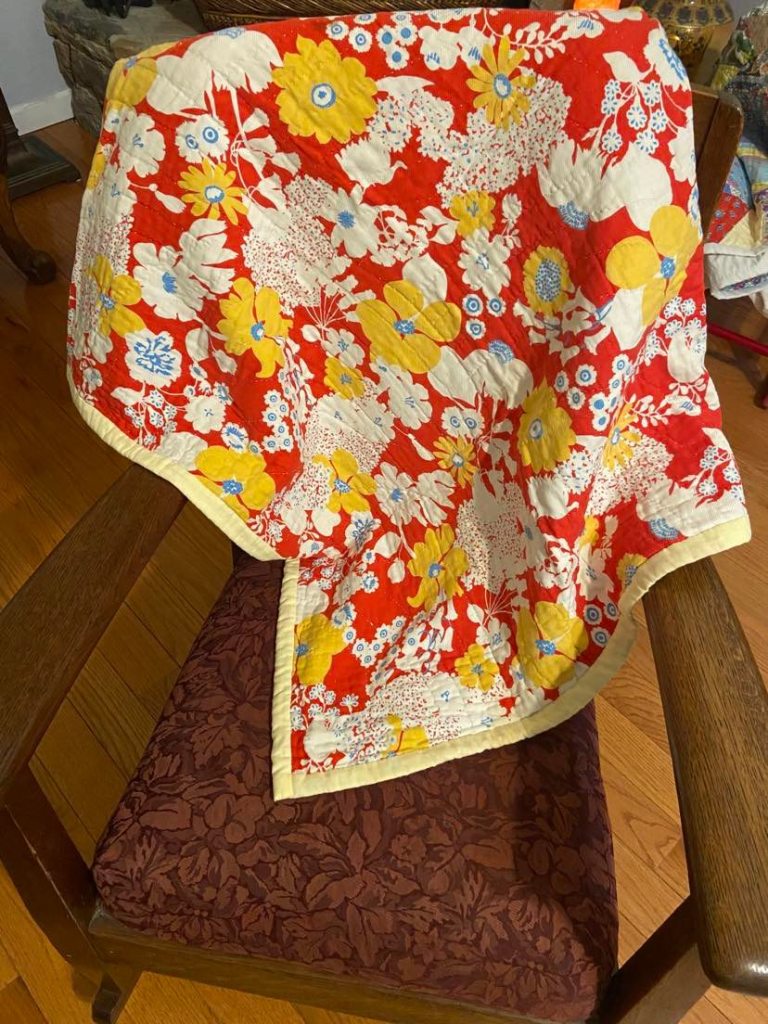
-Tim Carmichael
Enjoyed this story?
If Appalachian Memories has brought you a story you enjoyed or helped you discover something new about the mountains, your support helps me continue researching and sharing Appalachian history, traditions, and memories.


 Echoes of Appalachia
Leave a comment