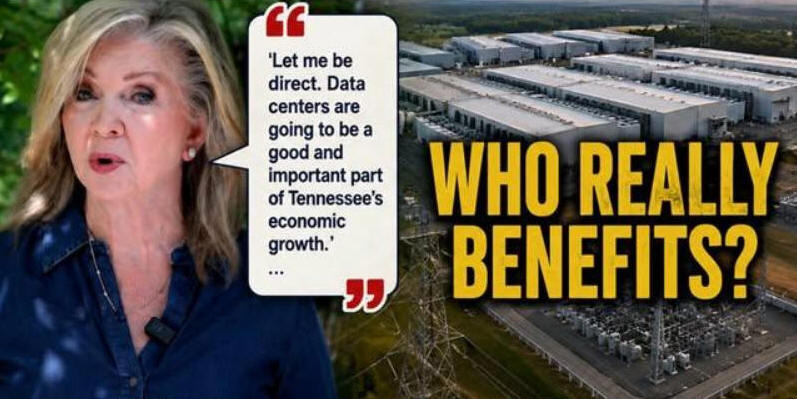
Across Tennessee, the rural view is changing. Rolling Appalachian hills, working farms and open acreage increasingly sit beside massive industrial campuses built to house servers, cooling equipment and electrical infrastructure. These facilities can cover hundreds of thousands of square footage while presenting a largely sealed exterior to nearby communities. For residents watching farmland give way to hyperscale development, the issue reaches beyond aesthetics. It concerns who controls land, who pays for infrastructure, who receives the economic gains and who carries the long-term costs.
That debate has become entangled with the 2026 campaign of U.S. Sen. Marsha Blackburn, a Republican seeking the Tennessee governorship. Blackburn has presented Tennessee’s agricultural heritage as a central part of her political message. In a July 2026 statement, she described agriculture as part of the state’s foundation and farmers as the backbone of Tennessee’s economy, while pledging support for agricultural communities and opposition to foreign purchases of farmland. At the same time, Blackburn has described data centers as an important part of Tennessee’s economic growth. The two positions can coexist, yet their collision raises a practical question: how much rural land and public infrastructure should Tennessee devote to a rapidly expanding technology sector?
Campaign finance records add another layer to that question. Newly filed Tennessee disclosures show Blackburn’s gubernatorial campaign received $121,352.54 from individuals affiliated with artificial intelligence companies and organizations. Employees of Anthropic contributed about $53,000, while Oracle employees contributed $41,852.54, bringing those two companies alone to $94,852.54. Additional contributions included $10,600 from a researcher connected with the AI Futures Project, $10,600 from a policy director at the Secure AI Project and $5,300 from Darwin AI chief executive Noam Maital. Several individual donations reached Tennessee’s $5,300 statewide candidate limit for a primary or general-election campaign.
The donor records establish financial contributions from people connected to companies operating in the artificial intelligence and technology sectors. They cannot establish that any donor received a policy favor in exchange for a contribution, and the records alone cannot prove a causal connection between individual donations and Tennessee’s data-center policies. The timing remains politically relevant, however, because Blackburn has publicly endorsed data centers as a source of economic growth while her campaign has received substantial contributions from people affiliated with companies involved in the broader AI economy.
Tennessee’s tax structure provides another concrete part of the story. The Tennessee Department of Revenue lists electricity purchased by a qualified data center under a special state sales-tax rate of 1.5 percent, compared with the state’s general sales-tax rate of 7 percent on most taxable purchases. The special treatment can reduce operating costs for facilities that consume enormous quantities of electricity, giving Tennessee an economic-development tool aimed at attracting capital-intensive technology projects. For residents, the central policy question becomes how the public benefits from that incentive compare with infrastructure demands created by large-scale facilities.
Electricity represents only one resource issue. Cooling systems can require substantial water, and Tennessee has specific regulatory requirements for certain withdrawals. The Tennessee Department of Environment and Conservation says users proposing to withdraw at least 10,000 gallons per day from surface or groundwater sources must register the withdrawal, while additional permits can apply to facilities drawing directly from surface waters or altering aquatic resources. A 2025 water-use analysis identified a Google data-center facility in Montgomery County with roughly 499.5 million gallons of annual withdrawal and approximately 424.7 million gallons of annual consumption. That single facility illustrates the scale possible when computing infrastructure and water-intensive cooling operate together.
The Nashville debate offers a local example of how those resource questions reach a community. DC BLOX has pursued a data-center project beside Nashville Zoo, with project documents describing a 69,000-square-foot facility and a larger future expansion. Later reporting described a combined proposal reaching roughly 202,000 square feet and power demand of up to 50 megawatts. Zoo officials raised concerns involving groundwater, stormwater infrastructure, endangered species and the surrounding community, while Metro officials moved toward new land-use rules and a temporary moratorium. The controversy eventually drew hundreds of thousands of petition signatures and became one of Nashville’s most visible development disputes of 2026.
Blackburn entered that dispute in June, saying data centers would be an important part of Tennessee’s economic growth while urging developers to reconsider the proposed location beside the zoo. Her position drew a distinction between the technology sector itself and the siting of an individual facility. That distinction matters because a statewide growth policy can support continued development while local officials impose restrictions on specific projects, especially when questions involve schools, conservation areas, utilities or surrounding neighborhoods.
The debate over corporate development also recalls an earlier Tennessee crisis involving a different industry and a different resource: prescription drugs. Blackburn, then a member of the U.S. House, co-sponsored H.R. 471, the Ensuring Patient Access and Effective Drug Enforcement Act of 2015. The legislation later became part of the 2016 federal law bearing that title. Government records describe the law as an effort to improve enforcement concerning prescription-drug diversion and abuse. Blackburn and other supporters presented the legislation as a way to establish clearer enforcement standards while preserving patient access to medication.
The law later became a major subject of criticism in reporting on the opioid epidemic. The Washington Post reported that DEA officials and former officials believed provisions supported by the pharmaceutical industry weakened the agency’s ability to act against distributors suspected of sending unusually large quantities of controlled substances into communities. A 2017 Post investigation described the law as reducing one of the DEA’s strongest tools for confronting drug companies suspected of allowing prescription pain pills to move outside legitimate distribution channels. Those reports also documented extensive lobbying by major drug distributors and employment relationships between the pharmaceutical industry and former federal officials.
A careful comparison requires limits. The opioid legislation involved prescription-drug distribution and federal enforcement, while today’s data-center expansion involves land use, electricity, water and technology investment. The two episodes involve different laws, industries and regulatory systems. The common policy question concerns how government weighs economic activity against public costs when powerful industries seek favorable operating conditions. That question can be examined through records rather than through an assumption that the two situations are identical.
For Tennessee, the current data-center debate is moving toward concrete policy questions. Communities can examine zoning rules, water availability, grid capacity, tax incentives, economic-development agreements, emergency planning and the location of large facilities before projects become permanent features of a county. State officials can also examine whether special tax treatment remains appropriate as electricity demand from artificial intelligence and cloud computing grows. Developers, meanwhile, can point to construction spending, jobs, tax revenue and digital infrastructure as reasons for continued investment.
Blackburn’s own public statements illustrate the tension at the center of the debate. Her campaign promotes Tennessee’s agricultural heritage and rural economy, while Blackburn has also described data centers as important to future economic growth. Her June comments on the Nashville Zoo project added a qualification: development can continue while individual locations receive greater scrutiny. Campaign-finance disclosures place more than $121,000 in AI-connected contributions alongside that policy discussion, creating a factual record for voters to examine when considering how campaign money, economic development and technology policy intersect.
The larger question for the 2026 governor’s race extends beyond one candidate or one proposed facility. Tennessee is deciding how rapidly to convert available land and public infrastructure into a platform for high-density computing. That decision involves competing interests: farmers protecting productive acreage, communities planning around utilities, technology companies seeking dependable power and water, local governments seeking revenue, and residents concerned about long-term changes to their surroundings. The evidence now available allows Tennesseans to examine those interests directly, compare proposed safeguards with promised economic gains, and decide what balance they want state policy to pursue.
As policymakers continue evaluating the expansion of digital infrastructure across the state, municipal leaders face mounting pressure to balance corporate expansion with environmental protection and resource management. Utility providers must constantly recalculate power generation capacities to accommodate enormous surges in electricity demand driven by machine learning clusters and cloud storage providers. State legislators are frequently lobbied by industry stakeholders who promise massive employment figures during the construction phase alongside significant municipal tax contributions once operations commence. Public utility commissions must simultaneously weigh the impact of heavy energy consumption on residential ratepayers, ensuring that everyday consumers do not shoulder an unfair financial burden for grid upgrades necessitated by private corporate entities.
Furthermore, rural counties possess limited legal frameworks for regulating massive industrial buildings that masquerade as quiet commercial offices. County commissioners often find themselves navigating complex zoning codes originally written for light manufacturing rather than twenty-first-century server farms consuming megawatts of power daily. Environmental advocates consistently point out that municipal water treatment plants and natural aquifers face unprecedented strain when massive cooling infrastructure operates continuously year-round. Public engagement sessions frequently overflow with concerned citizens demanding comprehensive environmental impact statements before any heavy construction permits receive final approval from local zoning boards.
Campaign contributions from technology executives and policy directors introduce an additional layer of scrutiny regarding how political campaigns handle corporate interests during election cycles. Watchdog groups analyze every quarterly financial disclosure to determine whether large donations correlate with favorable regulatory outcomes or legislative support for technology incentives. Candidates seeking statewide office must carefully articulate their economic visions to reassure traditional agricultural communities that their livelihoods will remain protected amid rapid industrialization. Balancing the competing priorities of high-tech economic growth and rural preservation remains one of the most challenging governance dilemmas facing Tennessee leadership today. Please get out and vote in the mid-terms and stop Blackburn from taking over Tennessee and turning it into one giant data center.
-Tim Carmichael


Leave a comment