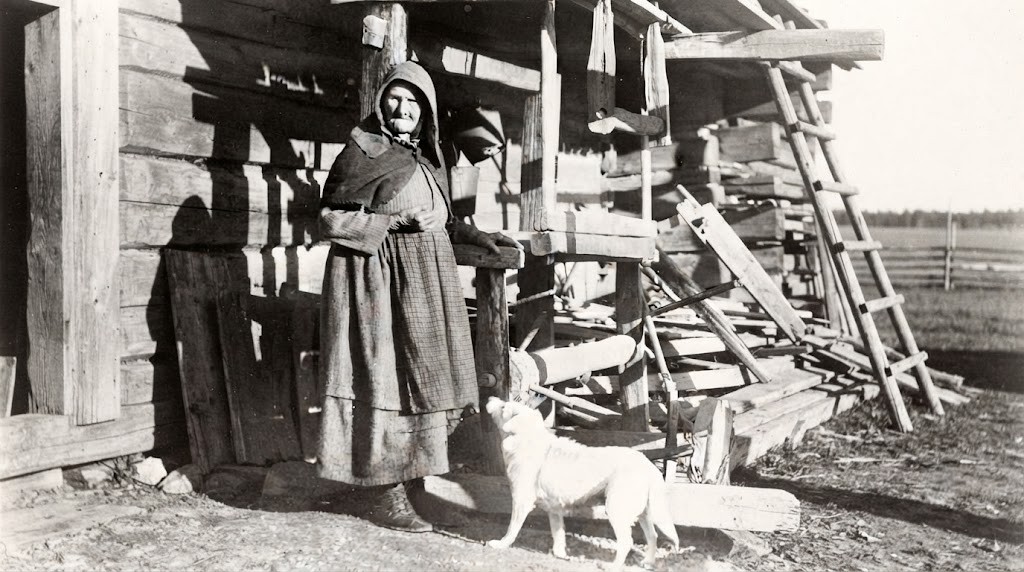
In the autumn of 1910, thousands of visitors streamed through the Great Appalachian Exposition in Knoxville, past exhibits celebrating the region’s coal, timber, and industry. Among the crowds, one attraction drew lines that stretched for hours: a replica log cabin, built plank by plank to honor a woman who had already outlived most of her century.
Her name was Mary Foust. She was over one hundred years old, and she had walked out of Lone Mountain to stand before the modern world for the first time in her long life.
Visitors came to watch her cook. She prepared traditional mountain meals over an open hearth, feeding curious onlookers and, remarkably, several visiting U.S. Presidents who wanted to shake the hand of a woman who remembered a country that barely existed anymore. Cameras flashed. Reporters scribbled. For a few weeks, Mary Foust became one of the most photographed faces in Tennessee.
Then the exposition closed, the crowds dispersed, and Mary turned around and walked home. She climbed back into Foust Holler, closed the door of her one-room cabin, and resumed a life that belonged to the nineteenth century, as though the twentieth had merely been a rumor she chose to ignore.
To understand why fame held little pull over her, one has to travel back nearly ninety years, to when Mary was twelve. Her family made a six-day trek through unbroken wilderness toward the fledgling settlement of Knoxville, then a cluster of perhaps two hundred souls clinging to the edge of the frontier. The journey tested every ounce of strength in her young body. Threat of attack from native warriors forced the family into a blockhouse for shelter, where they waited out the danger in cramped silence, uncertain whether morning would come safely.
That walk left its mark. Her feet toughened against the stones and roots of mountain trails, and something inside her hardened too, an early lesson that survival demanded grit rather than comfort. She carried that lesson for the rest of her exceptionally long life.
Decades later, in June 1846, Mary said goodbye to her husband as he set off to volunteer in the Mexican-American War. She traveled with him as far as his mustering point, savoring what turned out to be their final moments together, though neither of them knew it at the time. Seven months passed. Then word finally reached the holler: he had died far from home, in a war fought over territory most mountain families would never see.
Mary found herself alone, raising two children, Coon and Sis, in a landscape where the nearest neighbor might live a ridge or two away. There was little time for grief. There was only work.
What followed was a life built entirely on her own hands. She split her own fence rails, swinging an axe with the same steady rhythm year after year. She hunted wild game to feed her children, tracking deer and small animals through forest that offered no mercy to the unprepared. She tanned hides herself, turning raw skins into leather through a process that demanded patience and strength in equal measure. Every stitch of clothing worn in her household came from her own spinning wheel and needle, thread pulled from wool she had carded herself.
Distance never stopped her from reaching her neighbors. Without roads or telephone lines, she relied on a signal horn, its call carrying across the ridges of Lone Mountain in a code understood by the scattered families who lived within earshot. A certain pattern of blasts might mean trouble. Another might call for help with a harvest. It was a language written entirely in sound, passed down and preserved through use alone.
While the rest of the nation raced toward railroads, electricity, and factories, Mary Foust remained rooted to her holler, tending crops, curing meat, and living by the rhythms her grandmother would have recognized.
She survived the War of 1812 as a small child. She survived the death of her husband in the Mexican-American War. She survived the Civil War, which tore through Tennessee and left scars across families throughout the region. She survived long enough to see automobiles appear on distant roads and to watch the twentieth century arrive in full.
In June 1915, five years after cooking for Presidents and standing at the center of a national exhibition, Mary Foust died at the age of 103. Her passing drew little attention from the newspapers that had once celebrated her. There were no headlines marking the loss of a woman who had witnessed a full century of American transformation while remaining almost entirely untouched by it. She simply returned to the mountain that had shaped her, folded back into the soil of Foust Holler, where her cabin still stood among the trees.
The exposition crowds had called her a marvel. The mountain called her home.
-Tim Carmichael
 Echoes of Appalachia
Leave a comment