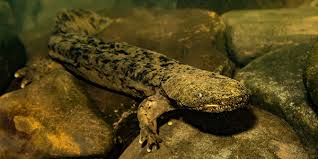
In the cold, rocky streams of the Appalachian Mountains lives one of the most mysterious and ancient creatures in North America: the hellbender salamander. Few people have ever seen one in the wild, yet the legend of this remarkable animal has grown in the mountain communities for centuries. Known for its enormous size, with adults reaching lengths of up to two and a half feet, the hellbender holds a presence that feels almost prehistoric. With wrinkled, flabby skin, a broad head, and a flattened body designed for moving under boulders, it gives an impression of something primeval, a living remnant of a world far older than ours. Its size alone makes it the largest salamander in North America, a title that has carried both admiration and harm. Too often, fascination has led people to harass the animal in the very waters it depends on to survive.
I have lived my entire life in the Appalachian Mountains. I have crossed many miles of streams and creeks hiking in the Smoky Mountains, and in over fifty years of living here, I have only seen two hellbenders. That illustrates the rarity of encountering one in the wild. Their elusiveness adds to their allure and to the responsibility of leaving them undisturbed.

The Appalachian range has long been a safe home for hellbenders. These salamanders require cold, clean, oxygen rich streams with abundant rocks and stable gravel beds. Their skin allows them to absorb oxygen directly from the water, so their survival depends on pristine conditions. For this reason, the Appalachian Mountains with their network of shaded creeks, tumbling streams, and remote valleys provide an ideal refuge. Unfortunately, what once felt like endless habitat has shrunk dramatically. Logging, agriculture, mining, and construction have muddied countless streams with silt and pollution. Without clear flowing water, hellbenders cannot breathe properly, cannot hunt crayfish effectively, and cannot raise their young. The result has been a steep decline across their range.
Despite this alarming trend, people continue to disturb the hellbender, often through actions that may seem harmless at first glance. One common activity is the moving of rocks in creeks. Families, hikers, and anglers often shift boulders to build dams or to flip them while searching for crayfish, insects, or even the salamanders themselves. For a creature that depends on the shelter of heavy stones to avoid predators and regulate body temperature, this intrusion can be devastating. When a rock is pried up and left out of place, the hidden chambers that once offered protection collapse or remain open to currents. Eggs may be exposed to silt, and adults may lose the few hiding spots that exist in a stretch of water. To the person turning the rock, it might feel like play, yet to the salamander it is a home destroyed.
Even more troubling is the pursuit of hellbenders by those who seek to capture or kill them. Folklore has long painted the animal in strange colors, sometimes as a monstrous presence in the creek, sometimes as a source of luck or a challenge to catch. In certain communities, stories of children or adults hunting for “devil dogs” or “snot otters,” as the hellbender has been called, have persisted. People lift rocks, wade through cold pools, and chase a glimpse of the wrinkled creature sliding beneath the gravel. Too many end up pulling them from the water, either out of curiosity or the desire to prove they found one. These actions almost always harm the salamander. Their sensitive skin tears easily when handled, and stress can lead to long term decline or death. Some have even been killed outright by those who fear them or mistake them for venomous animals. In truth, hellbenders are harmless. They neither bite aggressively nor pose danger to people. They ask for nothing more than to be left in peace.
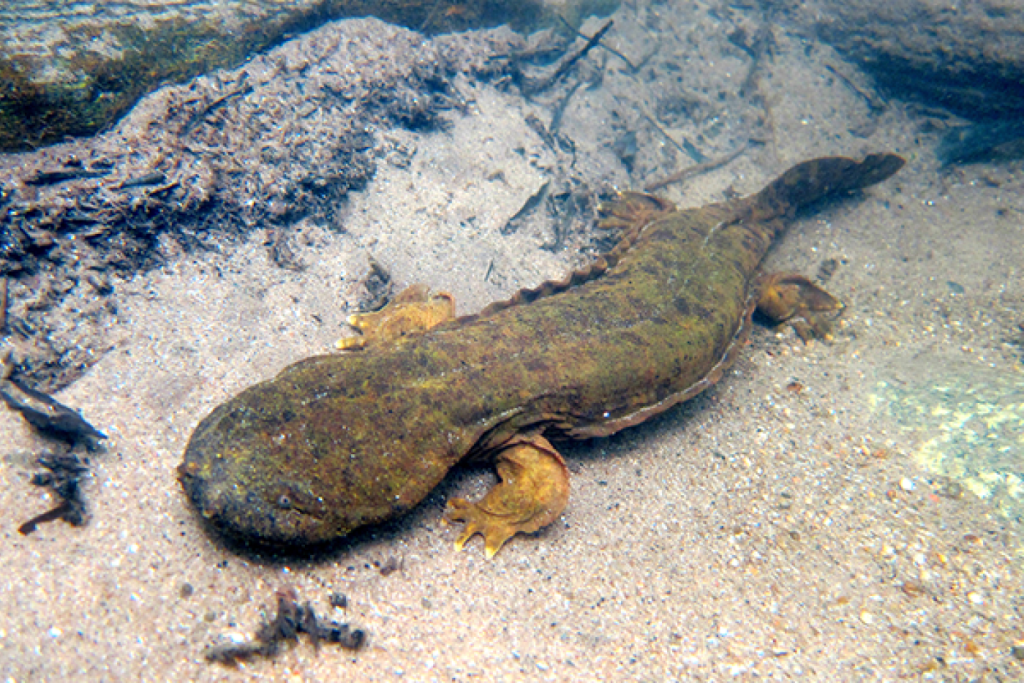
What makes this harassment even more tragic is the rarity of an encounter. Even in streams where hellbenders still survive, they remain elusive. Their habits are secretive, with most of the day spent hidden under rocks or wedged in crevices. Night brings a slow emergence to search for crayfish, worms, or small fish, yet even then they slip quietly through the current. Many biologists have worked for years in Appalachian waters and only seen a handful. For the casual visitor to a creek, the chances of encountering one naturally are slim. My own experience illustrates this perfectly. Even after decades of exploring and hiking these mountains, seeing a hellbender occurs only as a fleeting glimpse. This rarity should make the few sightings even more precious, a moment to marvel and move on, rather than an invitation to capture or disturb.
Despite appearances, the hellbender is a fragile species. The same skin that allows it to breathe also exposes it to pollution and disease. Agricultural runoff filled with fertilizers and pesticides poisons the water. Sediment from development fills the gaps between rocks, smothering eggs and reducing oxygen flow. Rising temperatures warm the shallow creeks, limiting how far the salamanders can live upstream. Dams block the natural flow of rivers, isolating populations that once exchanged genes across long stretches. All of this has led scientists to describe the species as highly imperiled. While it has not disappeared entirely from Appalachia, its decline is so stark that many streams where locals once remembered seeing them are now silent of their presence. To say the hellbender is extinct in much of its former habitat is sadly accurate.
The irony is that many people pursue the animal precisely because it feels so rare. In a culture fascinated by what remains hidden, the hellbender has become a prize to uncover. Anglers share stories of lifting boulders until one slithered out, hikers brag of catching sight of a massive salamander in a shaded pool, and thrill seekers talk of grabbing one with bare hands. All of this reflects human fascination with discovery, yet it overlooks the damage done. Every rock turned, every body touched, every photograph taken while holding one above the water robs the salamander of safety. What seems like an innocent encounter may reduce an already fragile population further.
In truth, the hellbender has already chosen its home wisely. The Appalachian Mountains, with their mix of hardwood forests and mountain streams, have sheltered this creature for thousands of years. They thrive in water shaded by overhanging trees, cooled by mountain springs, and fed by rains that tumble across mossy rocks. They seek the darkest crevices beneath stones, carving out dens where males guard eggs with patient dedication. This is where they belong, and where they wish to remain. The salamander is not a visitor to Appalachia, it is a resident far older than the generations of people who now hike its trails and fish its streams.
When people walk through these mountains, they are stepping into a landscape that already holds a delicate balance. Moving rocks for fun or exploration may feel like a small act yet multiplied across thousands of visitors it dismantles the very foundation of the hellbender’s existence. Hunting for them, whether with nets or hands, robs future generations of the chance to know they still swim in those waters. Even photography, when it involves removing them from the stream, carries harm. To honor Appalachia is to honor the creatures that shaped it long before human arrival.
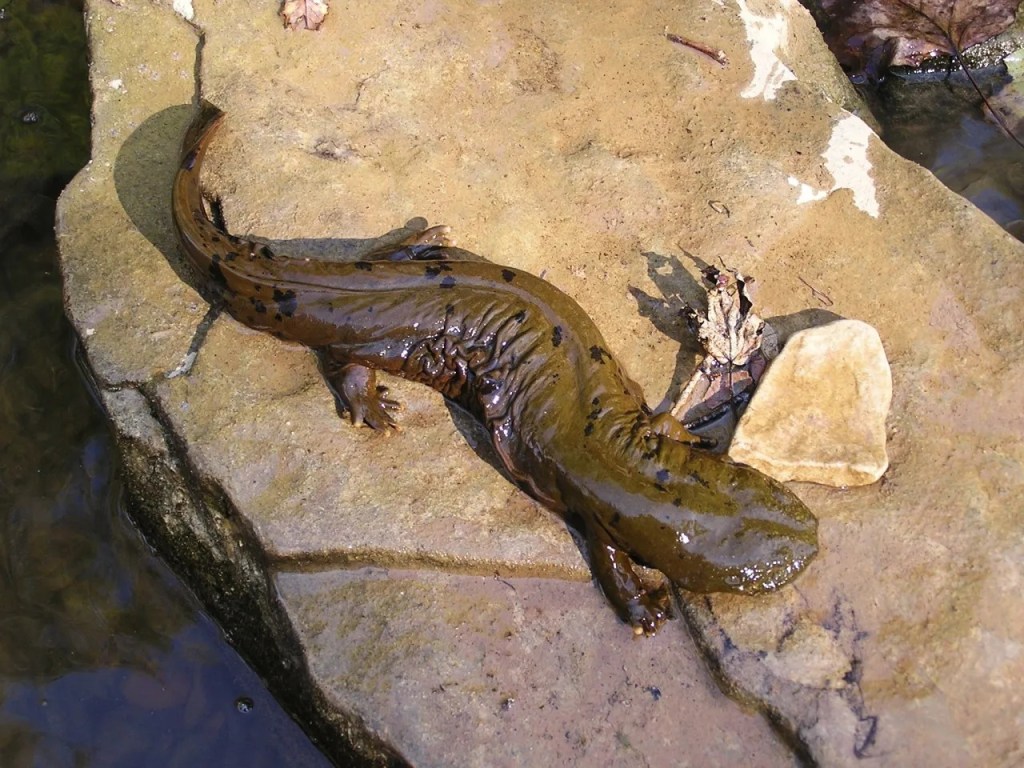
There is also an ethical weight to this issue. To disturb a creature so rare, so dependent on fragile conditions, for the sake of curiosity or bragging rights, reflects more on human behavior than on the salamander. Respect for wildness demands restraint. The true reward of encountering a hellbender lies in the quiet knowledge that they still endure, hidden in the cold waters, unseen yet alive. To leave them undisturbed is to participate in their survival. Every untouched rock, every moment of restraint, is an act of conservation.
For those who wish to help rather than harm, the path is clear. Keep streams clean by supporting practices that reduce pollution and erosion. Encourage education in local communities so that children grow up seeing the hellbender as a treasure worth protecting rather than a curiosity to capture. Participate in conservation programs that restore habitats, plant streamside trees, and monitor water quality. Most importantly, when near a creek in Appalachia, resist the urge to disturb rocks or creatures. Listen to the water, watch the ripples, and know that beneath the surface may rest a salamander whose survival depends on your decision to walk away.
The story of the hellbender is a reminder of how easily fascination can slip into harm. It is also a story of endurance. Despite centuries of change, this giant salamander still clings to life in the mountain streams. Its presence is a living connection to an older world, one that predates roads, towns, and even the concept of Appalachia as we know it. To allow it to fade away would be to lose a vital part of the region’s heritage.
So, the call is simple: leave the hellbender alone. Let it remain a hidden guardian of the Appalachian waters; an ancient resident whose wrinkled skin and secretive life add mystery to the creeks. In a time when so many species vanish due to human interference, restraint becomes an act of respect. The greatest way to honor the hellbender is to walk past the stream, let the rocks lie, and remember that some wonders thrive only when left unseen.
-Tim Carmichael


 Echoes of Appalachia
Leave a reply to Tim Carmichael Cancel reply