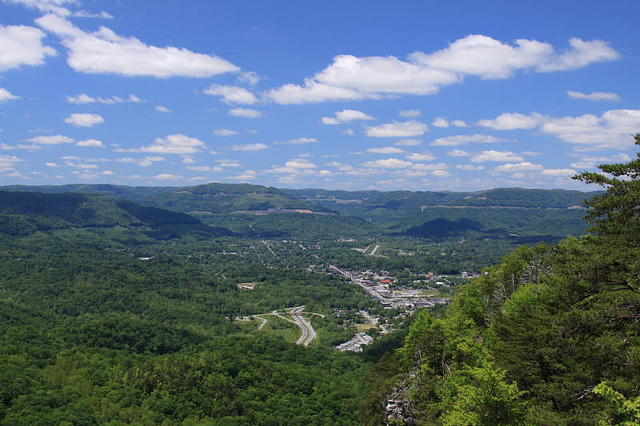
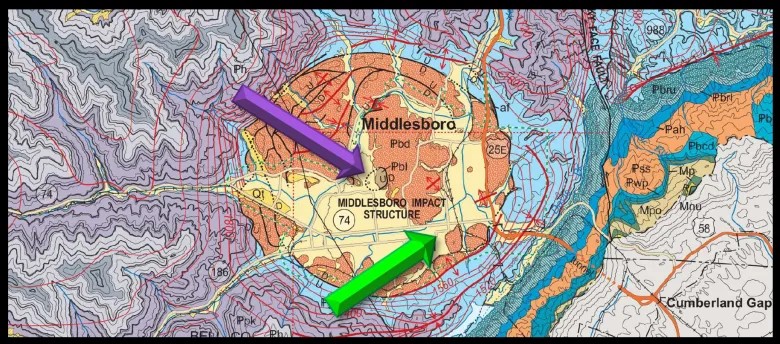
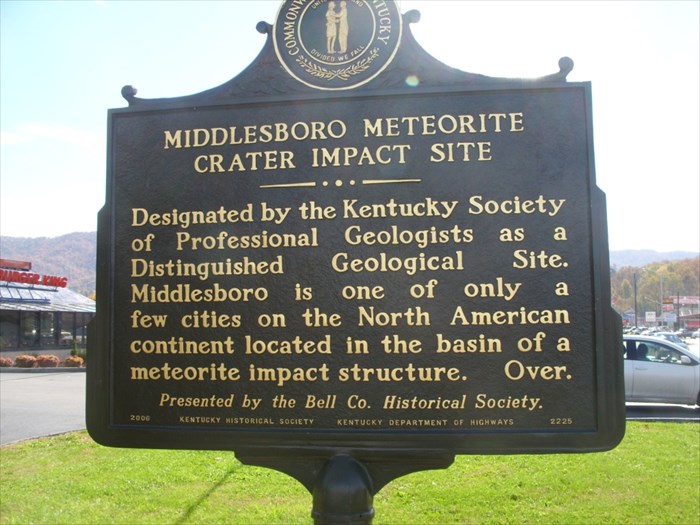
Tucked into the far southeastern corner of Kentucky, where the borders of Tennessee and Virginia meet the Appalachian Mountains, the city of Middlesboro occupies one of the most unusual settings in North America. From the surrounding ridges, the landscape appears almost theatrical in its symmetry. A circular valley spreads out below, ringed by steep wooded slopes that rise like the rim of a colossal bowl. Streets form a grid across the flat basin floor. Homes, schools, and businesses stand where unimaginable forces once reshaped the Earth. Middlesboro rests entirely within the boundaries of the Middlesboro Crater, a meteorite impact structure measuring roughly 3.7 miles in diameter.
The crater formed less than 300 million years ago during the late Paleozoic Era, long before human settlement, long before the Appalachian Mountains reached their present form. A meteorite traveling at tremendous speed slammed into the ancient landscape. The collision released energy far beyond any volcanic eruption in recorded history. Rock layers folded, fractured, and lifted. Shock waves radiated outward through sandstone, shale, and limestone. In a matter of seconds, a cavity opened in the crust and rebounded, leaving a circular depression encircled by uplifted ridges.
Over millions of years, erosion softened the raw edges of the impact. Sediments accumulated on the basin floor. Forests covered the rim. By the time European settlers arrived in the eighteenth and nineteenth centuries, the crater blended into the broader Appalachian terrain. Few suspected its violent origin. To early residents, the circular valley offered fertile soil and natural shelter from wind. The ring of mountains provided timber and coal. The shape of the land felt distinctive, though its story remained hidden in stone.
In the late nineteenth century, industrial investors recognized opportunity in the basin. Coal seams ran through the surrounding hills. Iron ore deposits appeared nearby. Railroad access expanded across the region. Middlesboro emerged during the boom of American steel production, and planners laid out the town with ambitious vision. The flat crater floor allowed for an orderly street grid rarely seen in mountainous Appalachia. Entrepreneurs promoted the city as the “Magic City” due to its rapid growth. Buildings rose, furnaces roared, and mines tunneled into the encircling ridges.
The geology beneath this growth held secrets that puzzled observers. Rock layers appeared tilted and disrupted in unusual patterns. Miners encountered formations that seemed out of place. The circular valley shape defied easy explanation. Some speculated about volcanic origins. Others proposed gradual erosion shaped by water. The true cause remained elusive until the mid twentieth century.
In 1966, geologist Robert S. Dietz arrived in the area with a hypothesis. Dietz had spent years studying meteorite impact structures and developing criteria to identify them. Across the world, scientists were beginning to recognize that circular depressions once attributed to volcanism often traced back to cosmic collisions. Dietz examined sandstone exposures within and around Middlesboro. There, he found definitive evidence known as shatter cones.
Shatter cones form under intense, high pressure shock waves generated by meteorite impacts or nuclear explosions. Their distinctive conical shapes feature radiating striations that resemble the tail of a horse. No ordinary geologic process produces them. Volcanic activity cannot replicate their patterns. Tectonic forces fail to create their precise geometry. When Dietz identified shatter cones in local rock, the conclusion became clear. Middlesboro sat within an astrobleme, a scar left by a meteorite strike.
The discovery transformed scientific understanding of the region. The circular valley emerged as a classic example of an impact crater modified by erosion. The surrounding ridges represented uplifted rock pushed upward during the rebound stage of impact. Beneath the city streets lay fractured and brecciated formations, rocks shattered and welded together by pressure and heat. The coal seams miners pursued had endured shock metamorphism, altering their structure in subtle ways.
Middlesboro gained distinction as the only city in the world built entirely inside a confirmed meteorite impact crater where industrial development required adaptation to impact altered geology. Other towns exist near craters. Some communities sit partly within impact structures. Middlesboro alone occupies the whole basin floor, its civic life unfolding within a cosmic footprint.
Mining operations in the area faced challenges tied directly to the crater’s formation. The impact fractured rock layers into complex patterns. Coal seams that might run in predictable lines elsewhere twisted and dipped unexpectedly around the basin. Faults crisscrossed the subsurface. Engineers developed specialized surveying and extraction methods to track seams through disrupted strata. Traditional assumptions about Appalachian coal geology required revision inside the crater.
The unusual structure also influenced groundwater flow. The fractured rock created pathways for water movement that differed from surrounding terrain. Managing water infiltration in mines demanded careful planning. Drainage systems accounted for the radial and concentric fracture networks born from the ancient collision. Each tunnel carved into the rim passed through rock that once absorbed a shock wave powerful enough to reshape the crust.
Above ground, the crater rim frames daily life. Cumberland Gap National Historical Park borders the area, preserving mountain passes once used by Indigenous peoples and early settlers. From elevated trails, visitors can look down upon the circular basin and trace its outline with the eye. The symmetry becomes unmistakable from that vantage. The city grid rests within a natural amphitheater formed by extraterrestrial force.
The impact occurred during a period when the supercontinent Pangaea assembled. The Appalachian region experienced tectonic compression as ancient landmasses collided. The meteorite strike added sudden violence to an already dynamic environment. Though erosion erased the original crater walls, geophysical surveys reveal the deeper structure. Studies of gravity anomalies and subsurface imaging confirm the basin’s circular outline beneath layers of sediment.
Shatter cones remain the most dramatic field evidence. Visitors can view examples displayed in local institutions and along certain outcrops. Each cone preserves the direction of shock wave propagation. Their surfaces record an instant when pressure exceeded tens of thousands of atmospheres. Holding a shatter cone connects present observers with a moment nearly three hundred million years in the past.
The city’s identity intertwines with this geological heritage. Schools teach students about the crater’s origin. Museums interpret the science for tourists. Civic pride draws strength from uniqueness. Middlesboro occupies a site shaped by forces that link Earth to the broader solar system. The ground beneath homes and businesses carries memory of a cosmic encounter.
Urban development within the crater required careful consideration of topography. The basin floor offers level terrain rare in mountainous Appalachia. This flatness supported rail yards, factories, and residential blocks. At the same time, the encircling rim limits outward expansion. Growth tends to follow the natural boundary set by the crater walls. Roads curve toward gaps in the rim where passes allow connection to neighboring valleys.
Environmental management also reflects crater geology. Soil composition within the basin differs from that on surrounding slopes. Sediment derived from uplifted rim rock accumulated over ages, creating fertile ground suited to agriculture and landscaping. Flood control planning accounts for the bowl shaped drainage pattern. Rainwater flows inward from the rim toward central low points before exiting through natural channels.
The story of Middlesboro demonstrates how scientific insight can reshape perception of familiar landscapes. For decades, residents lived within a circular valley without understanding its extraterrestrial origin. The 1966 work of Robert Dietz provided the missing piece. By identifying shatter cones in local sandstone, he confirmed that a meteorite impact created the structure. His findings joined Middlesboro to a global network of recognized impact sites such as Meteor Crater in Arizona and Chicxulub crater in Mexico.
Each crater tells a story about Earth’s vulnerability to cosmic events. The Chicxulub impact contributed to the mass extinction that ended the age of dinosaurs. Meteor Crater in Arizona offers a relatively young and well preserved example of a smaller strike. Middlesboro represents an older, eroded structure integrated into a living community. Its basin hosts neighborhoods, schools, and parks rather than standing as an isolated landmark.
Scientists continue to study the crater to refine estimates of its age and the size of the impacting body. Analysis of shocked minerals and stratigraphic relationships narrows the time frame to less than 300 million years ago. Estimates suggest the meteorite may have measured several hundred meters across. The energy released would have equaled many millions of tons of TNT. Such force carved a cavity that time gradually softened into the valley visible today.
For residents, daily routines unfold atop rock once subjected to catastrophic shock. Children play sports in fields layered over fractured sandstone. Drivers navigate streets aligned across an ancient impact floor. Miners who once worked the rim encountered coal shaped by both tectonic compression and extraterrestrial violence. The city stands as a testament to human adaptability within landscapes forged by extreme events.
Middlesboro invites reflection on deep time. The crater formed long before mammals dominated the planet. It endured continental drift, mountain building, and climatic shifts. Erosion sculpted its rim while forests rose and fell across epochs. Human history occupies only a fleeting chapter in comparison. Yet within that brief span, people built a community that thrives inside a cosmic scar.
The circular valley that once marked devastation now frames civic life. Church steeples rise where shock waves once rippled through stone. Schools educate new generations inside a basin blasted from the crust. The discovery of shatter cones by Robert Dietz revealed a hidden narrative etched in rock. Middlesboro’s story unites astronomy, geology, industry, and community in a single landscape.
Standing on the crater rim at sunset, one can trace the arc of mountains encircling the city. The symmetry speaks of sudden impact and long endurance. Few places on Earth offer such a direct connection between cosmic events and everyday existence. Middlesboro occupies that rare space, a city cradled within a meteorite crater, shaped by ancient collision and sustained by human strength.
-Tim Carmichael
 Echoes of Appalachia
Leave a comment