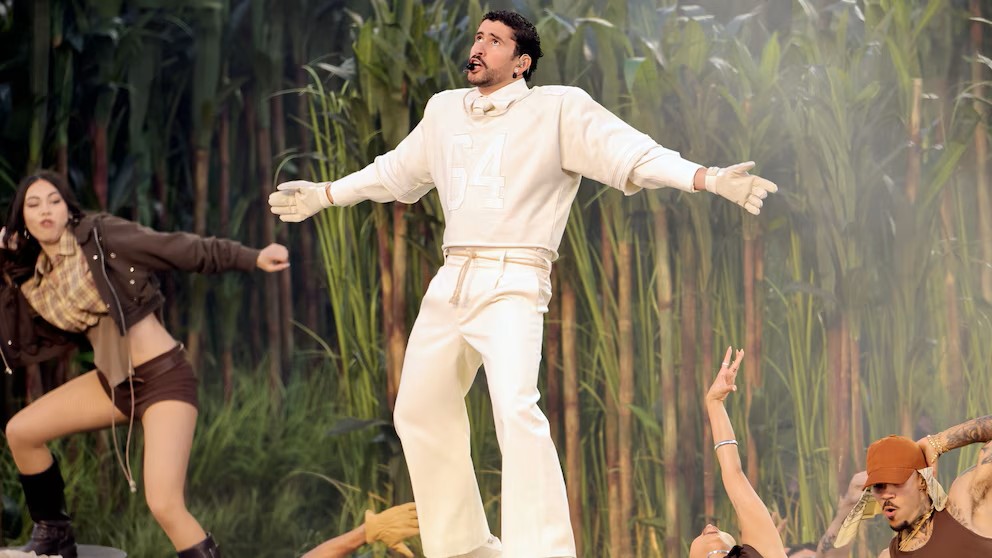
When I sat down to watch Bad Bunny’s halftime show, I did not know exactly what to expect. I had already seen reactions online. Praise, anger, confusion, certainty. All of it swirling together. I watched with curiosity rather than anticipation, and within minutes it became clear that what I was seeing was not just a performance.
What Bad Bunny delivered was not provocation. It was not disrespect. It was not an attack. It was love. Bold, expansive, and deeply American in a way that feels increasingly rare.
On the largest stage in the world, before more than one hundred million viewers, he made a choice that was both simple and radical. He told the truth about who he is. He sang every single word in Spanish. Not a chorus translated for comfort. Not a token verse. Every lyric. No apology. No explanation. Just confidence, joy, and presence.
That choice was not exclusionary. It was honest.
The football field transformed into something else entirely. Sugarcane rose from California turf, a reminder that American land has always carried more stories than the narrow ones we are taught. Roots run deeper than fences. History stretches wider than borders.
The performance unfolded as a celebration. Lady Gaga appeared and moved effortlessly into salsa, not as a novelty but as a participant. Ricky Martin lit up the stadium with the ease of someone who has spent a lifetime crossing borders through music. Dancers filled the field. At one point, a couple was married right there in the middle of it all. Love made literal. Ordinary and sacred at the same time.
Then came a moment that carried more weight than any spectacle ever could. Bad Bunny handed his Grammy, won just days earlier for Album of the Year, to a young boy standing beside him. The child looked up with wide eyes, the way children do when something clicks and they realize the future might actually have room for them. That single gesture said more about legacy than any speech ever could.
And then, standing there as the son of a truck driver and a schoolteacher from Vega Baja, Puerto Rico, Bad Bunny looked out at the crowd and said, simply, God bless America.
Not sarcastically. Not defensively. As a statement of belonging.
What followed was the heart of the night. He began naming countries slowly. Chile. Argentina. Uruguay. Paraguay. Bolivia. Peru. Ecuador. Brazil. Colombia. Venezuela. Panama. Costa Rica. Nicaragua. Honduras. El Salvador. Guatemala. Mexico. Cuba. The Dominican Republic. Jamaica. The United States. Canada.
And then his voice broke as he said, Mi patria, Puerto Rico. Seguimos aquí.
My homeland, Puerto Rico. We are still here.
As he spoke, flags appeared. Not one. All of them. Carried across the field by dancers and musicians, moving together instead of competing for space. The stadium screens filled with the only message that mattered.
THE ONLY THING MORE POWERFUL THAN HATE IS LOVE.
I cried. Fully. Without shame.
Because what I was watching felt like the America I believe in. Not the narrow, fearful version that insists patriotism has one language and one face. But the real one. The complicated one. The multilingual, multicolored country built by people who came from everywhere and made something together.
That truth is not limited to cities or coastlines. It lives in Appalachia too.
Appalachia is so often flattened into a caricature, held up as shorthand for some imagined pure America. In reality, it is a tapestry of immigrants. Scots Irish. German. Welsh. African. Indigenous. Eastern European. Coal towns built by hands from across oceans. Music shaped by African rhythms and Celtic melodies. Food, faith, and language braided together over generations.
Every one of us has immigrant blood running through our veins. Every one of us.
There is no untouched origin. No pure line. No version of America that was not built by people who came from somewhere else, speaking something else, carrying stories they refused to abandon. Appalachia did not emerge from isolation. It emerged from convergence.
That is the America this performance honored.
That is the America I want children to inherit. One where, when the whole world is watching, a Puerto Rican artist can stand on the biggest stage imaginable, sing in his mother’s language, bless every nation in the hemisphere, and remind us that belonging is not conditional.
And yet, almost immediately, that vision was rejected by powerful voices.
The performance was dismissed as terrible. People claimed no one could understand it. It was framed as an insult rather than a gift.
Let that sit.
A celebration of culture, unity, and shared humanity was reduced to something foreign. Something threatening. Something labeled disgusting.
That reaction says nothing about the performance and everything about the lens through which it was viewed.
Strength does not fear diversity. Patriotism does not shrink at the sound of another language. Love of country does not require erasing the people who make it real. When someone hears the voices of hundreds of millions across this hemisphere and feels attacked, that is not leadership. It is poverty of the soul.
As if to underline the contrast, an alternative performance was offered up as the so called real America. Framed as wholesome. Familiar. Safe. As if this country has a velvet rope. As if culture needs permission. As if you only count if you sing in English.
The implication was clear. Some Americans belong more than others.
Here is the part we do not talk about enough.
What people post in moments like this does not disappear. Screenshots live forever. Children grow up and scroll back. One day, your kids and their kids will see what you celebrated and what you rejected. They will know which side you stood on when love and fear were placed next to each other.
History is not only written in textbooks. It is written in timelines.
And when future generations look back at this moment the way we look back at other turning points, moments when the moral choice was clear but not universally taken, they will recognize the pattern. They will see who dismissed joy as threat. Who labeled inclusion as offense. Who chose resentment over belonging.
This is not written with anger. It is written with sadness.
Because hate is an inheritance no one asks for, yet it gets passed down, belief by belief, post by post. It hardens people. It shrinks them. It convinces them the world is smaller than it actually is.
Bad Bunny did not need to shout slogans. He did not need to attack anyone. He did not need to explain himself. He simply showed us what America looks like when it is not afraid.
An America where culture is shared, not policed. Where language is music, not menace. Where flags from every nation in this hemisphere can walk across the same field together.
More than one hundred million people saw that.
And no angry post, no dismissive comment, no attempt to rewrite the moment can take it away.
Because once love is seen at that scale, it cannot be unseen.
And that is why it mattered.
-Tim Carmichael
 Echoes of Appalachia
Leave a comment