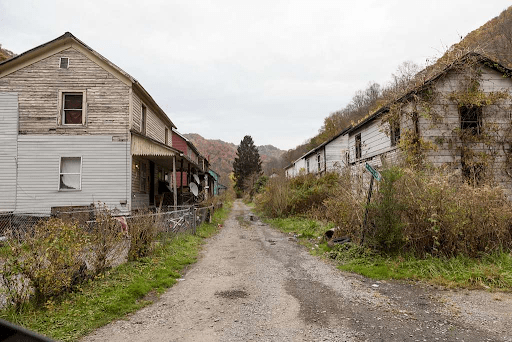
The Appalachian Mountains have always carried an air of mystery. Their slopes hold mist in the mornings, and their valleys seem to echo with old voices. In the shadows of those ridges lie towns that time has nearly erased. Houses lean under moss and ivy, sidewalks vanish into soil, and church steeples rise above forests that have taken back their own.
These are the lost towns of Appalachia, once thriving communities that grew with promise and faded into silence. Each one tells a story of struggle, labor, and memory, where human dreams met the unyielding reality of mountain life. Many of these places now stand as haunting reminders of a past shaped by coal mining, isolation, and resilience.
The Birth of the Company Towns
During the early twentieth century, the demand for coal transformed the Appalachian landscape. Mining companies arrived from faraway cities, carving rail lines through the wilderness and creating entire coal mining towns almost overnight. A typical Appalachian company town appeared within weeks. Rows of simple wooden houses lined the hillsides, a general store carried company goods, and a school and church sat proudly near the center.
Coal fueled America’s progress, and the Appalachian region became its heart. Towns like Thurmond in West Virginia, Lone Mountain in Kentucky, and Clinchco in Virginia once pulsed with industry and hope. Steam whistles signaled the start and end of each workday, while the rumble of coal trains echoed through the hollows. Children played barefoot in cinder yards, mothers hung laundry scented with coal smoke, and men returned home with the day’s dust clinging to their clothes.
For families in these mining towns, life was hard yet full of pride. They worked the earth and built tight-knit communities that stood together through every season. Each home, each church, and each school became a testament to endurance and faith in the promise of the mountains.
Decline and Departure
The decline of these Appalachian coal towns came quietly and then all at once. As mines began to run dry or became too costly to operate, jobs disappeared. Automation and changing energy markets took away livelihoods that had supported generations. Companies closed their offices, trains stopped running, and stores shuttered their doors.
Whole towns vanished in a matter of years. Families packed their few belongings into old cars and left behind the houses they had built with their own hands. Schools grew empty. Churches fell silent. In some hollows, a handful of families stayed, watching as nature reclaimed what industry had abandoned.
Rain washed the soot from rooftops, vines crept up old porches, and the forest returned with quiet patience. The echoes of human life lingered in the sound of the wind moving through the trees.
Echoes in the Forest
A walk through these Appalachian ghost towns today feels like stepping into a forgotten world. The crunch of gravel beneath your boots might be the remains of a main street. A pile of bricks could have been a bank or a corner store. The soft whistle of wind through broken windows carries the faintest sound of laughter, the hum of a coal train, or the rhythm of a church hymn once sung in harmony.
Dogwoods bloom where children once played. Rusted bridges stretch across creeks that miners used to cross at dawn. The scent of pine needles and damp earth fills the air, mingling with traces of memory that seem to rise from the ground itself.
These abandoned communities of Appalachia reveal the truth that nature never forgets. It does not destroy; it simply restores. The silence feels like reverence, a reminder that the mountains endure long after human ambition fades.
Towns That Time Forgot
Across Appalachia, countless names survive only in memory or on faded road signs along forgotten highways.
Thurmond, West Virginia: Once a bustling rail town that handled millions of tons of coal each year, it now stands as one of the best-preserved ghost towns in the region. Visitors can still walk its narrow streets and imagine the lives that once filled them.
Kaymoor, West Virginia: Perched on the cliffs of the New River Gorge, this former mining town closed in the 1960s. Wooden stairs still descend toward the ruins of the old tipple, where iron and timber mingle with moss and silence.
Cumberland, Virginia: Flood control projects swallowed entire neighborhoods here, leaving only the memory of homes beneath the water. Families still gather each summer to share stories of the place that once was.
Elkhorn City, Kentucky: Once a lively hub for rail workers, it now wears a quieter face. Empty storefronts line the streets where dance halls and theaters once echoed with laughter and music.
Each of these Appalachian ghost towns holds a fragment of history. Together they form a mosaic of courage, struggle, and loss that defines the story of the mountains.
The People Who Remember
Though many towns have disappeared, the memories remain alive in the hearts of those who once called them home. Family albums hold black-and-white photos of men covered in coal dust and women standing proudly on front porches. In kitchens across Appalachia, jars of mining scrip and rusted tools sit beside old letters and postcards.
Elders tell stories of communities that thrived on hard work and friendship. They speak of Saturday night dances, church picnics, and the steady rhythm of life before the last whistle blew.
Some descendants return each year to visit what remains of their family’s homes. They sit in folding chairs among the trees, share lunches, and speak the names of those who came before them. Through these gatherings, they keep their heritage alive.
Local historians and volunteers now document these stories through oral histories, digital archives, and walking tours. Each recorded voice adds another thread to the fabric of Appalachian history, ensuring that these lost communities are never truly forgotten.
Preservation and Rediscovery
Interest in Appalachian ghost towns has grown among historians, photographers, and explorers. Hikers venture deep into the hills to find rusted mining equipment, forgotten cemeteries, and crumbling foundations hidden beneath vines.
Preservation is not easy. Harsh weather, remote terrain, and limited resources make restoration difficult. Yet those who work to preserve these towns see it as a calling. They know that every remnant tells a story of labor, love, and perseverance.
By protecting these sites, Appalachia safeguards more than old structures. It protects a living memory. Every beam of wood and every stone foundation stands as proof that these communities mattered, that they helped build the foundation of modern America.
What the Silence Teaches
To stand in an abandoned Appalachian coal town is to stand between two worlds. The forest hums with life, while beneath the soil lie the traces of human effort and hope. The silence speaks of endurance and renewal.
These lost towns are not simply ruins; they are lessons in humility. They remind us that every community rises, falls, and leaves something behind. They whisper that the mountains are eternal, patient observers of human history.
When you walk among the remnants, you feel a deep connection to those who came before. Their stories live on in the wind, in the water, and in the quiet heartbeat of the land.
A Living Legacy
The mountains remember everything.
Each ridge and holler holds the memory of those who carved a life from stone and timber, who raised children under the glow of kerosene lamps, and who built towns that once shined with purpose.
Though trains no longer roll through these valleys and the houses stand empty, the spirit of Appalachia remains alive. It moves in the rustle of leaves, in the creak of bridges, in the faint outline of foundations seen from mountain trails.
The lost towns of Appalachia still breathe through the stories of those who cherish them. They teach us that even as time moves forward, memory endures. The song of the mountains continues, carried by anyone who listens closely to the hills.
💌 Explore more Appalachian stories at Echoes of Appalachia. Subscribe to receive weekly tales from the mountains, history that still breathes in every ridge and river.
 Echoes of Appalachia
Leave a comment