
Grace Moore was born Mary Willie Grace Moore on December 5, 1898, in a small settlement called Slabtown, near Del Rio in Cocke County, Tennessee. Her family moved when she was very young, and she grew up in Jellico, a coal-mining town in the Cumberland Mountains near the Kentucky border. Life there was hard, and the music people made was often their only luxury — church hymns, fiddle tunes, and the ballads passed down through generations.

Grace showed an early interest in singing, and her family encouraged her. After finishing high school, she studied music briefly in Nashville, then moved on to Washington, D.C., and finally to New York City. To support herself, she sang in cafés and clubs while taking voice lessons. Her early performances weren’t glamorous, but they got her noticed.
By the 1920s, Grace was appearing in musical revues on Broadway. She had charm and presence, but what set her apart was her voice — a full lyric soprano that could carry emotion as easily as it carried a note. She wasn’t content with Broadway. She wanted opera.
So, she went to Paris to study. That move changed her life. She trained intensively and soon began performing in European opera houses. Critics noted not only her technical skill but her dramatic ability — she didn’t just sing roles, she inhabited them.
In 1928, she made her debut at the Metropolitan Opera in New York in Puccini’s La Bohème. It was a major breakthrough. Over the next several years, she became a regular presence there, singing roles in Tosca, Manon, and Louise, among others. She earned respect in a field not known for welcoming outsiders — especially not women from small Appalachian towns.
Hollywood came calling in the 1930s. Grace made several films, including One Night of Love, which earned her an Academy Award nomination for Best Actress — a rare honor for an opera singer. She managed to balance her opera career and film work, something few could do well. She also recorded extensively and toured internationally.
Despite her success, she stayed connected to her roots. She visited Tennessee often, spoke fondly of her upbringing, and used her influence to bring classical music to wider audiences. During World War II, she performed for American troops and participated in USO tours. She believed music should lift people up, not just entertain them.
Grace Moore was awarded several international honors during her life, including France’s Légion d’honneur. She was also given ceremonial titles by the state of Tennessee and received recognition from arts organizations across Europe and America.
She married Spanish actor Valentín Parera in 1931. They divided their time between the United States and Europe, maintaining homes in places like Connecticut, Cannes, and Los Angeles.
On January 26, 1947, Grace Moore was killed in a plane crash outside Copenhagen, Denmark. She was 48 years old. She had just performed in the city the night before. Among those who died in the crash was Prince Gustaf Adolf of Sweden. Her remains were returned to Tennessee, and she was buried in Chattanooga.
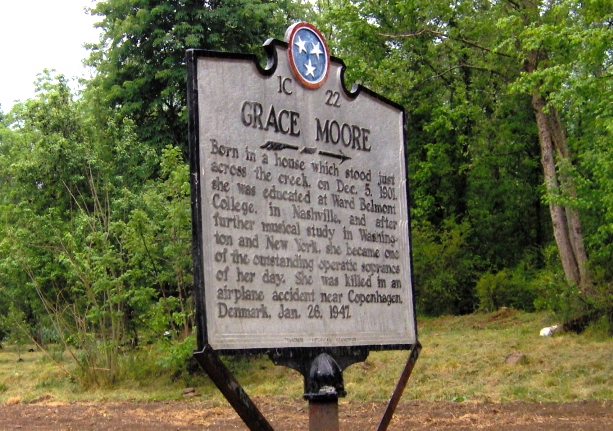
Today, a historical marker stands at her birthplace in Del Rio. It’s a quiet tribute to a woman whose voice traveled farther than most people from her part of the world could ever dream. She was known as “The Tennessee Nightingale,” and for good reason: she never stopped singing, and she never stopped representing the place that made her.
Grace Moore proved that you don’t have to be born in a palace to belong on a grand stage. Sometimes, you just need a voice — and the will to use it.
-Tim Carmichael
 Echoes of Appalachia
Leave a comment