The Appalachian dialect is a fascinating blend of sounds, words, and phrases that reflect the unique cultural history of the Appalachian region. Spanning across parts of the U.S. like eastern Kentucky, Tennessee, and West Virginia, the language spoken here is often misunderstood or mischaracterized, but it holds a rich depth of meaning for those who use it. From its distinctive pronunciation to its unusual vocabulary, Appalachian English is anything but ordinary.
Pronunciation: The Sounds of the Mountains
One of the most striking features of Appalachian English is its pronunciation. It’s not just a different accent—it’s a different way of articulating words, often in ways that might sound unfamiliar to those from other parts of the country.

Epenthetic “r”:
Take the word “wash,” for example. In Appalachian English, it’s pronounced “worsh,” with an extra “r” inserted. This epenthetic “r” is a signature trait of the dialect, showing up in several other words as well.
“-er” Sound for Long “o”s:
Another feature is the way long “o”s are pronounced. Words like “hollow” get pronounced “holler.” This shift can make the language sound more rounded, giving it a smooth, lyrical quality that’s uniquely Appalachian.
H-Retention:
When beginning a sentence with words like “hit,” you’ll hear the “h” clearly, which might sound a bit different from the way some other English speakers drop the “h.” So, “Hit the road” stays “hit” with a clear “h,” adding emphasis to the word.
Final “a”:
In some instances, like the word “opera,” it’s pronounced “opery” in Appalachian speech, keeping the final “a” in a way that makes the word stand out with a bit of a twang.
Intervocalic “s”:
You might also notice a distinct pronunciation of words like “greasy.” Instead of the standard “gree-zee,” it becomes “gree-zy,” with a “z” sound replacing the “s.” This change in sound can make certain words more fluid and quicker to say.
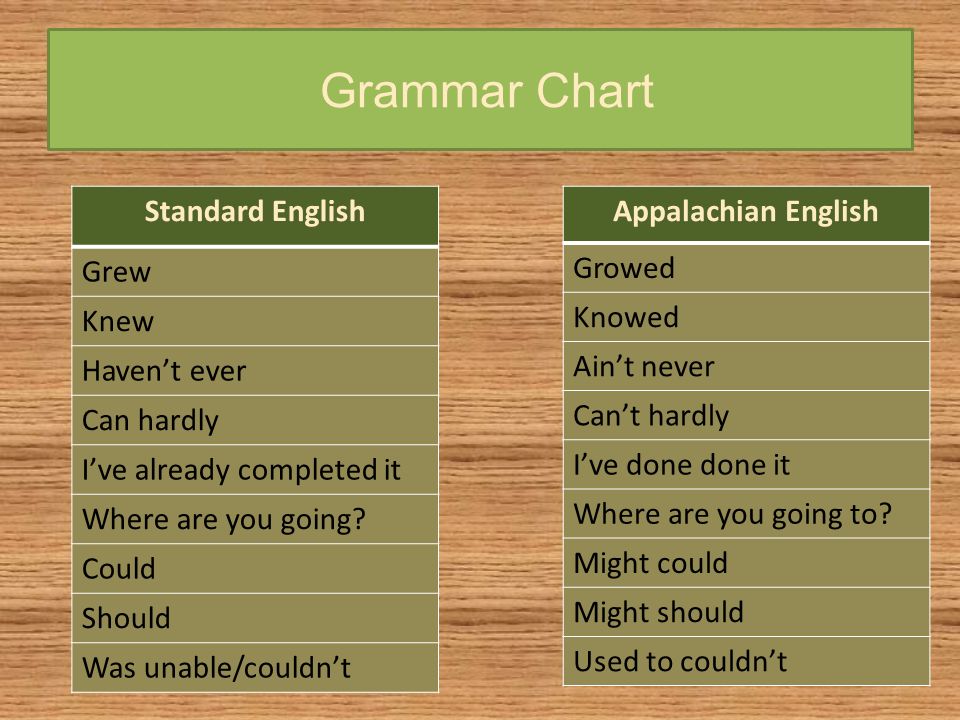
Vocabulary: Words with a Life of Their Own
Beyond the way people speak, Appalachian English has its own set of vocabulary that sets it apart from Standard American English. Many of these words carry meanings that might leave outsiders scratching their heads, but for those who use them, they’re as familiar as breathing.
Winder:
The word “winder” is used to refer to a window. It’s one of those small changes that often catches the ear of someone not from the area but is completely natural to anyone from the region.
Tater:
No one from the Appalachian region is likely to say “potato” when they can say “tater.” This charming shortening of the word gives it a warmth that matches the dish it refers to.
Sody-pop:
Soda or pop? In Appalachia, it’s “sody-pop.” Whether it’s Coke or something else fizzy, this term is commonly used across the mountains.
Chaney:
Instead of saying “china,” referring to fine dishes, many Appalachian speakers say “chaney.” It’s a small but significant difference in pronunciation, adding a layer of local flair to everyday items.
Britches:
“Britches” is the Appalachian word for trousers. While the rest of the world might say “pants” or “slacks,” those from the region proudly stick with “britches.”
Poke:
When it comes to carrying things, a “poke” is a bag. If you hear someone talk about a “poke of groceries,” they’re simply referring to a bag of items. It’s a quirky term, but it’s one that feels very much at home in this dialect.
Sallet:
You may have heard the word “salad,” but in Appalachian speech, it’s often pronounced “sallet.” It’s another example of how words are altered in this dialect, taking on a life of their own while still holding the same meaning.
Afeared:
If someone says they’re “afeared,” they’re simply saying they’re “afraid.” It’s a bit of an old-fashioned word, but it’s still very much in use in Appalachia.
Fixin:
Getting ready to do something? You’re “fixin” to do it. It’s a verb that’s used to indicate preparing to take an action, like “I’m fixin’ to head to the store.”
Allow:
In the Appalachian region, “allow” is used much like “suppose” or “think.” For instance, “I allow I’ll take a walk” means “I think I’ll take a walk.” It’s a word that adds a touch of color and personality to speech.

The Enduring Legacy of Appalachian English
While the Appalachian dialect may not always be fully understood by those from outside the region, it’s an integral part of the identity of people from the mountains. The words, the sounds, and the rhythms of Appalachian English tell the story of a place and a people who have weathered many changes but have never lost their distinctive voice.
This dialect isn’t something that just happens—it’s lived, it’s felt, and it carries meaning far beyond the words themselves. So, next time you hear someone say “worsh” instead of “wash” or refer to a “poke” instead of a bag, remember that these are more than just different ways of speaking. They’re a reflection of the community, the history, and the character of a region that’s kept its voice despite all the changes around it.
-Tim Carmichael

 Echoes of Appalachia
Leave a comment