
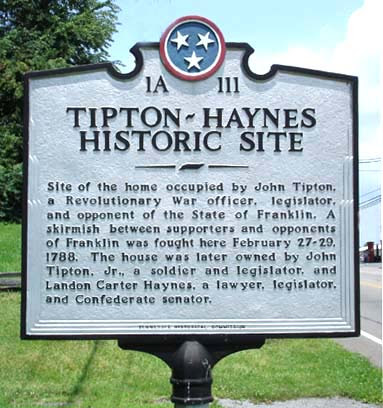
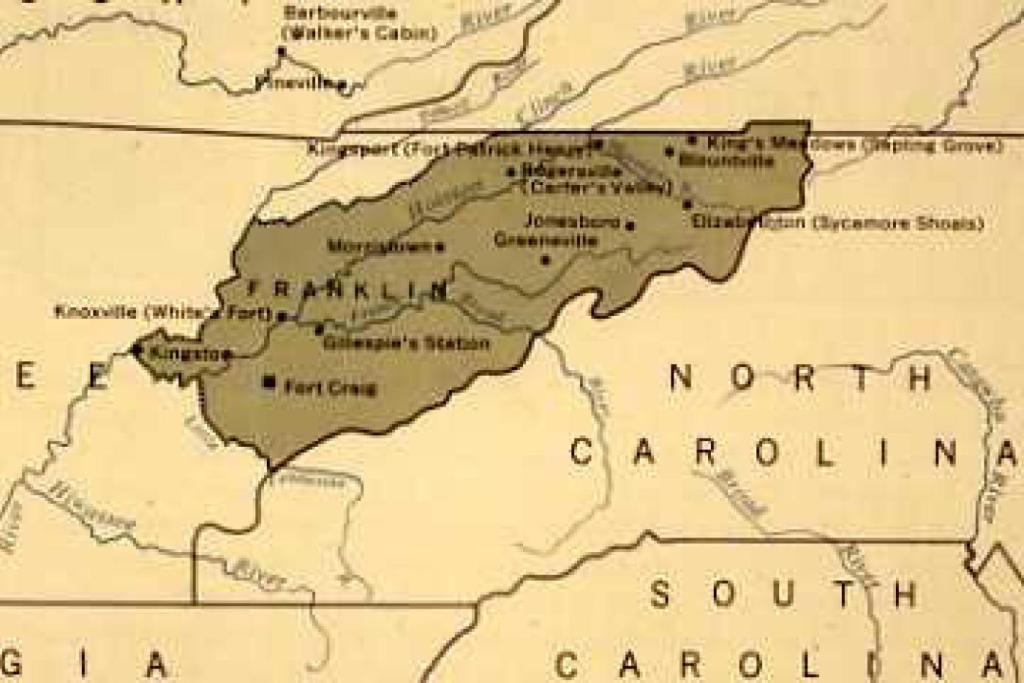
In the years following the American Revolution, a bold experiment in statehood emerged in the western frontier of North Carolina, giving rise to a short-lived entity known as the State of Franklin. Located in what is now East Tennessee, the State of Franklin was a unique attempt by settlers to assert control over their own destiny and create an independent state. This movement, fueled by local leaders, had both triumphs and failures, and its legacy remains part of Tennessee’s storied history.
In 1784, North Carolina took a momentous step by ceding a vast portion of its western lands to the newly formed United States government to help pay off war debts. However, settlers in the area—who faced a harsh frontier environment and constant threats from Native American groups—felt that North Carolina was no longer capable of providing them with protection. Discontent grew, and a group of settlers decided to take matters into their own hands. They declared their independence from North Carolina and founded the State of Franklin.
The movement for statehood was led by several notable figures, one of the most prominent being John Sevier. Sevier was a decorated veteran of the American Revolution and became the first governor of the State of Franklin. His leadership was crucial in organizing the new state and establishing its government, though the attempt to solidify its independence was marred by numerous challenges.
In addition to Sevier, other important figures of the time included David Crockett, who would later become a legendary frontiersman and politician, and General James White, the founder of Knoxville, a city that would play a crucial role in the state’s short history.
In December of 1784, the leaders of the State of Franklin drafted a constitution that was modeled after North Carolina’s own constitution. However, it included provisions that were more democratic, with lower qualifications for voters and officeholders. This constitution was a reflection of the settlers’ desire for self-governance and protection of their interests in a rugged frontier environment. Though this constitution provided a framework for governance, it was not enough to solidify Franklin’s place as an independent state.
The dream of the State of Franklin was short-lived, as a number of challenges proved insurmountable. One of the biggest obstacles was North Carolina’s refusal to acknowledge the legitimacy of the new state and its insistence on reclaiming the land. Furthermore, the fledgling state faced opposition from the federal government, which would not recognize Franklin as a legitimate state under the Articles of Confederation.
The leadership of Franklin attempted to negotiate directly with the Cherokee Nation to secure land treaties, but these negotiations conflicted with those made by the United States, further complicating matters. The federal government, struggling with its own post-revolutionary financial issues, was unwilling to extend full recognition to Franklin, leaving the settlers with little hope for lasting independence.
Another internal issue stemmed from divisions among the settlers themselves. As the state struggled to establish a cohesive government, factions within the community fought for control, making it increasingly difficult to maintain order and stability.
By 1790, the experiment of the State of Franklin had come to an end. The region was absorbed into the Southeast Territory, and Tennessee’s statehood was officially recognized in 1796. While the State of Franklin was brief, it had a lasting impact on the development of Tennessee and the American frontier.
The State of Franklin, though short-lived, serves as an intriguing chapter in the history of the United States. It represents the spirit of independence and self-determination that defined much of early American history. The figures who led the movement helped lay the groundwork for the eventual formation of Tennessee. Today, the story of the State of Franklin is a reminder of the challenges and complexities of forging a new state, and how local leaders can shape the course of history, even in the face of overwhelming obstacles.
-Tim Carmichael
 Echoes of Appalachia
Leave a comment