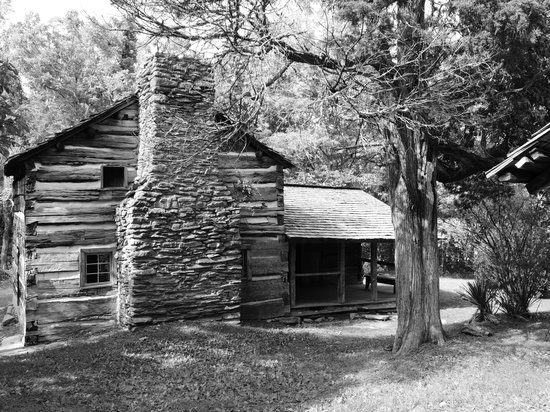
Hidden deep in the Great Smoky Mountains, near Little Greenbrier, lies the story of the Walker Sisters—a family of women who stood as the last holdouts of a disappearing way of life. Margaret, Polly, Martha, Louisa, and Hettie Walker lived their lives in defiance of modernity, keeping the traditions of early Appalachia alive long after the world around them had changed. Their tale is one of steadfast independence, self-sufficiency, and an unshakable connection to the land that nurtured them.
Life in the Smoky Mountains
Born between 1861 and 1879 to John and Mary Walker, the sisters grew up in a rugged cabin their father built in the Smokies. Raised in the traditions of subsistence farming, the Walkers lived off the land, tending livestock, growing crops, and making nearly everything by hand. Their way of life was rooted in the rhythms of nature, and while the world beyond their mountain hollow advanced with industry and technology, the Walker family remained committed to their simple, time-honored practices.
After their parents passed away, the remaining five sisters chose to stay on the family homestead, continuing to live as they always had. They spun their own wool, sewed their clothes, and used a wood-burning stove for cooking. The family’s cabin became a living testament to early Appalachian life, untouched by the modern conveniences that had swept across much of the country by the early 20th century.
The Encroaching National Park
In the 1930s, change came knocking on the Walkers’ door in the form of the Great Smoky Mountains National Park. The federal government was buying up land to create the park, and many mountain families sold their homes and moved away. But the Walker sisters refused to leave their land, determined to hold on to their home and heritage.
After some negotiation, the government agreed to let the sisters remain on their property for as long as they lived, though it was now technically part of the national park. They sold the land for $4,750, an arrangement that allowed them to keep living as they always had, while opening the door for future generations to learn from their way of life.
Steadfast in Tradition
Despite the world pressing in around them, the Walker sisters continued to live as their ancestors had. Their homestead became a popular stop for park visitors who were curious about these women seemingly frozen in time. The sisters welcomed the attention with grace, selling hand-knitted socks, quilts, and homemade molasses to tourists eager for a piece of their unique lifestyle. Yet they remained fiercely independent, never allowing the outside world to influence the traditions they held dear.
Their home was more than just a cabin—it was a portal to an older, slower way of life, one where self-sufficiency was a necessity, not a choice. Every item they made, from clothing to food, was a reflection of their skill, creativity, and deep connection to the land.
The End of an Era
As the years passed, the sisters began to pass away, one by one. By the time Hettie, the youngest, died in 1964 at the age of 82, the Walker Sisters’ Place had already become a symbol of a bygone era. Their homestead, now part of the Great Smoky Mountains National Park, stands as a monument to the simple yet profound life they led.
The cabin still exists today, nestled in the quiet hollow where the sisters spent their lives. A visit to the Walker Sisters Place offers a rare glimpse into the past. The home, surrounded by forest, remains a testament to the old Appalachian way of life—a life centered around self-reliance, community, and a deep respect for the natural world.
Legacy of the Walker Sisters
The legacy of the Walker sisters is not just their cabin or the crafts they made but the values they embodied. In a time of rapid change, they held firm to the traditions passed down through generations, reminding us that there is beauty and wisdom in living simply. Their lives offer a powerful contrast to today’s fast-paced, technology-driven world, showing that the most fulfilling paths are often the ones closest to the earth.
For visitors to the Smoky Mountains, hiking to the Walker Sisters Place feels like stepping back in time. The cabin, sheltered by the surrounding trees, offers a quiet sanctuary where the echoes of their lives can still be felt. It’s a place that speaks not just of survival, but of dedication—to family, to tradition, and to a way of life that is all but gone.
The Walker Sisters remain an enduring symbol of the Smoky Mountains, their story serving as a reminder of the rich cultural heritage that shaped Appalachia. Their homestead stands as a tribute to their determination to preserve the life they knew, offering inspiration to those who visit their small corner of the Smokies.
 Echoes of Appalachia
Leave a comment